p.215
p.226
p.237
p.247
p.273
p.295
p.306
p.317
p.325
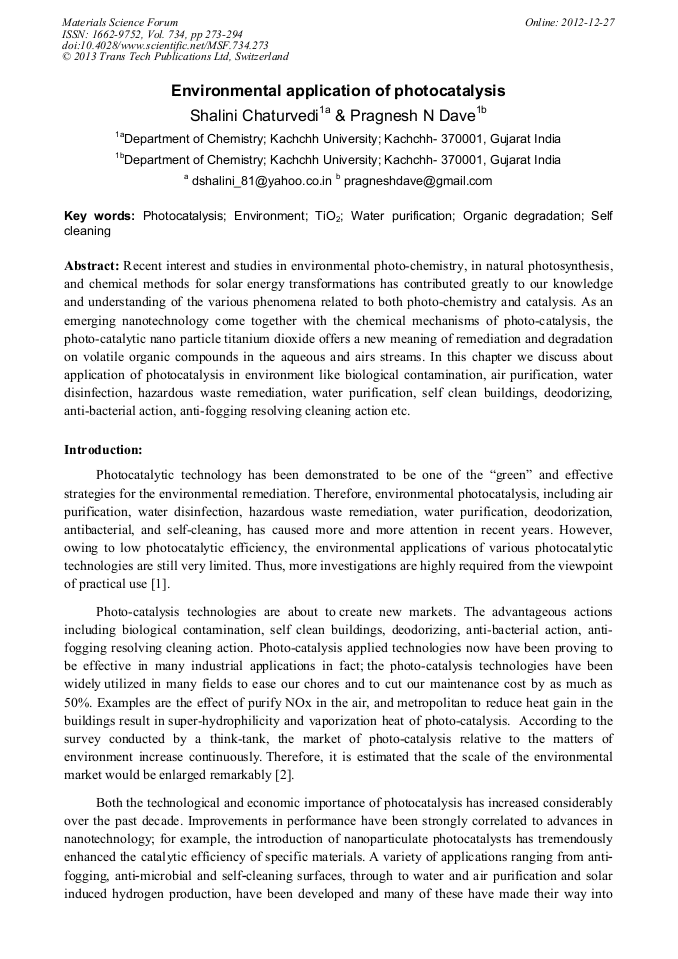
Environmental Application of Photocatalysis

Abstract:
Recent interest and studies in environmental photo-chemistry, in natural photosynthesis, and chemical methods for solar energy transformations has contributed greatly to our knowledge and understanding of the various phenomena related to both photo-chemistry and catalysis. As an emerging nanotechnology come together with the chemical mechanisms of photo-catalysis, the photo-catalytic nanoparticle titanium dioxide offers a new meaning of remediation and degradation on volatile organic compounds in the aqueous and airs streams. In this chapter we discuss about application of photocatalysis in environment like biological contamination, air purification, water disinfection, hazardous waste remediation, water purification, self-clean buildings, deodorizing, anti-bacterial action, anti-fogging resolving cleaning action etc.
Info:
Periodical:
Pages:
273-294
DOI:
Citation:
Online since:
December 2012
Authors:
Keywords:
Price:
Сopyright:
© 2013 Trans Tech Publications Ltd. All Rights Reserved
Citation:
[1] Photocatalysis for Water Treatment,; ObservatoryNANO, Briefing No. 2, August (2010).
[2] CHEMISTRY & MATERIALS: Applications of Photocatalysis, Observatory NANO, Briefing No. 10, February (2011).
[3] M.R. Hoffmann, S.T. Martin, W. Choi, and D. W. Bahnemannt; Environmental Applications of Semiconductor Photocatalysis, Chem. Rev. 95 (1995) 69-96.
[4] R. Rife; T.W. Thomas; D.W. Norberg; R.L. Fournier; F.G. Rinker; M.S. Bonomo, Environ. Prog.; 8 (1989) 167-173.
[5] R. B. Pojasek, Toxic and Hazardous Waste Disposal; Ann Arbor Science: Ann Arbor, MI, Vols. I-IV (1979).
[6] B.J. Kim; C.S. Gee; J.T. Bandy; C.S. Huang, Hazardous wastes treatment technologies, J. Water Pollut. Control Fed.; 63 (1991) 501-509.
[7] H.M. Freeman, Incinerating Hazardous Wastes; Technomic Publishing Co.: Lancaster, PA, (1988) 375-382.
[8] D.J. De Renzo, Biodegradation Techniques for Industrial Organic Wastes; Noyes Data Corporation: Park Ridge, NJ, (1980) 358-361.
[9] S. Kato and F. Mashio, Abtr. Book Annu. Meet. Chemical Society of Japan (1956), 223-225.
[10] K. Hashimoto, H. Irie, and A. Fujishima, TiO2 Photocatalysis: A Historical Overview and Future Prospects, AAPPS Bulletin 17 (6) December (2007).
[11] P. Pichat, In: Handbook of Heterogeneous Catalysis, G. Ertl, H. Knözinger, J. Weitkamp (eds. ), Wiley-VCH, Weinheim, vol. 4 (1997) pp.2111-2122.
[12] A. Fujishima, K. Hashimoto and T. Watanabe, TiO2 Photocatalysis, BKC, Tokyo, (1999).
[13] D.F. Ollis, Heterogeneous Photocatalysis Cat. Tech., 2 (1998) 149-157.
[14] P. Pichat, In: Chemical Degradation Methods for Wastes and Pollutants, M.A. Tarr (ed. ). Marcel Dekker, Inc. New York, Basel, pp.77-119, 2003. 5.
[15] L. Cermenati, P. Pichat, C. Guillard and A. Albini, New Probing the TiO2 photocatalytic mechanisms in water purification by use of Quinoline, photo-Fenton generated OH radicals and superoxide dismutase, J. Phys. Chem. B 101 (1997) 2650-2658.
DOI: 10.1021/jp962700p
[16] Y. Paz, Z. Luo, L. Rabenberg and A. Heller, Photooxidative Self-cleaning Transparent Titanium Dioxide Films on Glass, J. Mater. Res., 10 (1995) 2842-2848.
[17] V. Roméas, P. Pichat, C. Guillard, T. Chopin and C. Lehaut, Testing the efficacy and the potential effect on indoor air quality of a transparent self-cleaning TiO2-coated glass through the degradation of a fluoranthène layer, Ind. Eng. Chem. Res., 38 (1999).
DOI: 10.1021/ie990326k
[18] R. Asahi, T. Morikawa, T. Ohwaki, K. Aoki and Y. Taka, Visible-light photocatalysis in nitrogen doped titani- um oxides, Science, 293 (2001) 269-271.
[19] D. Shchukin, S. Poznyak, A. Kulak and P Pichat, TiO2-In2O3 photocatalysts: Preparation characterization and activity for 2-chlorophenol degradation in water, J. Photochem. Photobiol. A: Chem. 162 (2004) 423-430.
[20] P. Pichat, J. Disdier, C. Hoang-Van, D. Mas, G. Goutailler and C. Gaysse, Purification/deodorization of indoor air and gaseous effluents by TiO2 photocatalysis, Catal. Today, 63 (2000) 363-369.
[21] P. Pichat, S. Vannier, J. Dussaud and J. -P. Rubis, Field solar photocatalytic purification of pesticides containing rinse water from tractor cisterns used for grapevine treatment, Sol. Energy 77 (2004) 533-542.
[22] J. Disdier, P. Pichat and D. Mas, Measuring the effect of photocatalytic purifiers on indoor air hydrocarbons and carbonyl pollutants, J. Air Waste Manag. Assoc., 55 (2005) 88-96.
[23] D.M. Blake, Bibliography of Work on the Heterogeneous Photocatalytic. Removal of Hazardous Compounds from Water and Air; National Renew- able Energy Laboratory: Golden, CO. Available at: http: /www. osti. gov/bridge (accessed 2001).
DOI: 10.2172/789771
[24] A. Fujishima, K. Hashimoto, T. Watanabe: TiO2 Photocatalysis Fundamentals and Applications, 128-131, BKC, Inc. (1999).
[25] M. Kiyono: Sankatitan, Gihodo-shuppan, Japan, p.52 (1991).
[26] S. Sato, J.M. White, Photodecomposition of water over Pt/TiO2 catalysts, Chem. Phys. Lett., 72, (1980) 83-86.
[27] G. Hitoki, A. Ishikawa, T. Takata, J.N. Kondo, M. Har, and K. Domen: Ta3N5 as a Novel Visible Light-Driven Photocatalyst (λ_600 nm), Chem. Lett. (7) (2002) 736-737.
DOI: 10.1246/cl.2002.736
[28] Z. Zou, J. Ye, H. Arakawa: Photocatalytic behavior of a new series of In0. 8M0. 2TaO4 (M_Ni, Cu, Fe) photocatalysts in aqueous solutions, Catal. Lett., 75 (3-4) (2001) 209-213.
[29] H. Kato and A. Kudo: Highly Efficient Water Splitting into H2 and O2 over Lanthanum-Doped NaTaO3 Photocatalysts with High Crystallinity and Surface Nanostructure, J. Am. Chem. Soc., 125 (10) (2003) 3082-3089.
DOI: 10.1021/ja027751g
[30] T.N. Obee, R.T. Brown, Environ. TiO2 Photocatalysis for Indoor Air Applications: Effects of Humidity and Trace Contaminant Levels on the Oxidation Rates of Formaldehyde, Toluene, and 1, 3-Butadiene Sci. Technol. 29 (1995) 1223–1231.
DOI: 10.1021/es00005a013
[31] A.P. Jones, Indoor air quality and health, Atmos. Environ. 33 (1999) 4535–4564.
[32] A. Fujishima, K. Honda, Electrochemical Photolysis of Water at a Semiconductor Electrode, Nature 238 (1972) 37–38.
DOI: 10.1038/238037a0
[33] C.S. Kuo, Y.H. Tseng, C. Huang, Y. Li, Carbon-containing nano-titania prepared by chemical vapor deposition and its visible-light-responsive photocatalytic activity J. Mol. Catal. A: Chem. 270 (2007) 93–100.
[34] B. Kraeutler, A.J. Bard, Heterogeneous photocatalytic synthesis of methane from acetic acid - new Kolbe reaction pathwayJ. Am. Chem. Soc. 100 (1978) 4317–4318.
DOI: 10.1021/ja00475a049
[35] W. Choi, A. Termin, M.R. Hoffmann, The Role of Metal Ion Dopants in Quantum-Sized TiO2: Correlation between Photoreactivity and Charge Carrier Recombination DynamicsJ. Phys. Chem. 98 (1994) 13669–13679.
DOI: 10.1021/j100102a038
[36] M. Anpo, Photocatalysis on titanium oxide catalysts approaches in achieving highly efficient reactions and realizing the use of visible light Catal. Surv. Jpn. 1 (1997) 169–179.
[37] H. Yamashita, Y. Ichihashi, M. Takeuchi, S. Kishiguchi, M. Anpo, Characterization of metal ion-implanted titanium oxide photocatalysts operating under visible light irradiation, J. Synchrot. Radiat. 6 (1999) 451–452.
[38] R. Asahi, T. Morikawa, T. Ohwaki, K. Aoki, Y. Taga, Visible-Light Photocatalysis in Nitrogen-Doped Titanium Oxides, Science 293 (2001) 269–271.
[39] Q.L. Yu, H.J.H. Brouwers, Indoor air purification using heterogeneous photocatalytic oxidation. Part I: Experimental study, Applied Catalysis B: Environmental, 92 (2009) 454–461.
[40] M.R. Hoffmann, S.T. Martin, W. Choi, D.W. Bahnemann, Environmental. Applications of Semiconductor Photocatalysis, Chem. Rev. 95 (1995) 69–96.
DOI: 10.1021/cr00033a004
[41] K. Hashimoto, K. Wasada, M. Osaki, E. Shono, K. Adachi, N. Toukai, H. Kominami, Y. Kera, Photocatalytic oxidation of nitrogen oxide over titania–zeolite composite catalyst to remove nitrogen oxides in the atmosphere, Appl. Catal. B: Environ. 30 (3-4) (2001).
[42] C.H. Ao, S.C. Lee, Enhancement effect of TiO2 immobilized on activated carbon filter for the photodegradation of pollutants at typical indoor air leve Appl. Catal. B: Environ. 44 (2003) 191–205.
[43] C.H. Ao, S.C. Lee, Combination effect of activated carbon with TiO2 for the photodegradation of binary pollutants at typical indoor air level, J. Photochem. Photobiol. A: Chem. 161 (2-3) (2004) 131–140.
[44] C.H. Ao, S.C. Lee, J.C. Yu, Photocatalyst TiO2 supported on glass fiber for indoor air purification: effect of NO on the photodegradation of CO and NO2, Photochem. Photobiol. A: Chem. 156 (1-2) (2003) 171–177.
[45] S. Devahasdin, C. Fan, J.K. Li, D.H. Chen, S. Devahasdin, C. Fan, J.K. Li, D.H. Chen, J. Photochem. Photobiol. A: Chem. 156 (2003) 161–170, J. Photochem. Photobiol. A: Chem. 156 (2003) 161–170.
[46] H. Ichiura, T. Kitaoka, H. Tanaka, Photocatalytic oxidation of NOx using composite sheets containing TiO2 and a metal compound, Chemosphere 51 (2003) 855–860.
[47] W.K. Jo, K.H. Park, Heterogeneous photocatalysis of aromatic and chlorinated volatile organic compounds (VOCs) for non-occupational indoor air application, Chemosphere 57 (2004) 555–565.
[48] R. Pelton, X. Geng, M. Brook, Photocatalytic Paper from Colloidal TiO2 – Fact or FantasyAdv. Colloid Interface Sci. 127 (2006) 43–53.
[49] H. Wang, Z. Wu, W. Zhao, B. Guan, Photocatalytic oxidation of nitrogen oxides using TiO2 loading on woven glass fabric Chemosphere 66 (2007) 185–190.
[50] B.N. Shelimov, N.N. Tolkachev, O.P. Tkachenko, G.N. Baeva, K.V. Klementiev, A.Y. Stakheev, V.B. Kazansky, Enhancement Effect of of TiO2. Dispersion over Alumina on the Photocatalytic Removal of NOx Admixtures from O2-N2 Flow, J. Photochem. Photobiol. A: Chem. 195 (2008).
[51] J.S. Dalton, P.A. Janes, N.G. Jones, J.A. Nicholson, K.R. Hallam, G.C. Allen, Photocatalytic oxidation of NOx gases using TiO2: a surface spectroscopic approach, Environ. Pollut. 120 (2002) 415–422.
[52] S. Malato, P. Ferna´ndez-Iba´n˜ ez,., M. I. Maldonado, J. Blanco, W. Gernjak, . Decontamination and disinfection of water by solar photocatalysis: recent overview and trends. Catal. Today 147 (2009) 1-59.
[53] T Wintgens, F. Salehi, R. Hochstrat, T. Melin, Emerging contaminants and treatment options in water recycling for indirect potable use. Water Sci. Technol. 57 (2008) 99-107.
DOI: 10.2166/wst.2008.799
[54] S.D. Richardson, Environmental mass spectrometry: emerging contaminants and current issues. Anal. Chem. 80 (2008) 4373-4402.
DOI: 10.1021/ac800660d
[55] S. Sua´rez, M. Carballa, F. Omil, J.M. Lema, How are pharmaceutical and personal care products (PPCPs) removed from urban wastewaters? Rev. Environ. Sci. Biotechnol. 7 (2008) 125-138.
[56] B.R. Bradley, G.T. Daigger, R. Rubin, G. Tchobanoglous, Evaluation of onsite wastewater treatment technologies using sustainable development criteria. Clean Technol. Environ. Policy 4 (2002) 87-99.
[57] L. Lapen˜ a, M. Cerezo, P. Garcı´a-Augustin, Possible reuse of treated municipal wastewater for Citrus spp. plant irrigation. Bull. Environ. Contam. Toxicol. 55(1995) 697-703.
DOI: 10.1007/bf00203755
[58] W. Viessman Jr., M. J. Hammer, Water Supply and Pollution Control, sixth ed. Addison Wesley Longman Inc, California USA (1998).
[59] P.V.A. Padmanabhan, K.P. Sreekumar, T.K. Thiyagarajan, R.U. Satpute, K. Bhanumurthy, P. Sengupta, G.K. Dey, K.G.K. Warrier, Nano-crystalline titanium dioxide formed by reactive plasma synthesis. Vacuum 80 (2006) 11-12.
[60] U.I. Gaya, A.H. Abdullah, Heterogeneous photocatalytic degradation of organic contaminants over titanium dioxide: a review of fundamentals, progress and problems. J. Photochem. Photobiol. C: Photochem. Rev. 9 (2008)1-12.
[61] H. Yang, H. Cheng, Controlling nitrite level in drinking water by chlorination and chloramination. Sep. Purif. Technol. 56 (2007) 392-396.
[62] J. Lu, T. Zhang, J. Ma, Z. Chen, Evaluation of disinfection by-products formation during chlorination and chloramination of dissolved natural organic matter fractions isolated from a filtered river water. J. Hazard. Mater. 162 (2009) 140-145.
[63] H.M. Coleman, C.P. Marquis, J.A. Scott, S.S. Chin, R. Amal, Bactericidal effects of titanium dioxide-based photocatalysts. Chem. Eng. J. 113 (2005) 55-63.
[64] S. Esplugas, J. Gime´nez, S. Conteras, E. Pascual, M. Rodrı´guez,. Comparison of different advanced oxidation processes for phenol degradation. Water Res. 36, ( 2002) 1034-1042.
[65] M. Pera-Titus, V. Garcı´a-Molina, M. A. Ban˜ os, J. Gime´nez, S. Esplugas, Degradation of chlorophenols by means of advanced oxidation processes: a general review. Appl. Catal. B: Environ. 47 (2004) 219-256.
[66] S. Malato, P. Ferna´ndez-Iba´n˜ ez, M.I. Maldonado, J. Blanco, W. Gernjak, Decontamination and disinfection of water by solar photocatalysis: recent overview and trends. Catal. Today 147(2009) 1-59.
[67] S.N. Frank, A.J. Bard, Heterogeneous photocatalytic oxidation of sulfite in aqueous sulfite in aqueous solutions at semiconductor powders, J Phys Chem 81(1977)1484–1488.
DOI: 10.1021/j100530a011
[68] A.L. Pruden, D.F. Ollis, Photoassisted heterogeneous catalysis: The degradation of trichloroethylene in water, J Catal, 82 (1983) 404–417.
[69] C-Y Hsiao, C-L Lee, D. F. Ollis, Heterogeneous photocatclysis: degradation of dilute solutions of dichloromethane (CHCl2), chloroform (CHCl3), and carbon tetrachloride (CCl4) with illuminated TiO2 photocatalystJ Catal, 82 (1983) 418–423.
[70] T. Matsunaga, R. Tomado, T. Nakajima,H. Wake, Photoelectrochemical sterilization of microbial cells by semiconductor, FEMS Microbiol Lett, 29 (1-2) (1985) 211–214.
[71] B. O'Regan, M. Gr¨atzel, A low-cost, high- efficiency solar cell based on dye-sensitized colloidal. TiO2 films, Nature 353 (1991) 737–740.
DOI: 10.1038/353737a0
[72] M. Kitano, M. Matsuoka, M. Ueshima, M. Anpo, Recent developments in tita- nium oxide-based photocatalysts, Appl Catal A: Gen 325 (2007) 1–14.
[73] Adachi, Motonari, Yusuke Murata, Makoto Harada, and Susumu Yoshikawa. Formation of Titania Nanotubes With High Photo-Catalytic Activity., Chem. Lett., (8) (2000) 942-43.
DOI: 10.1246/cl.2000.942
[74] A. Ana, E. Almansa, A. Tejedor, A.R. Fernandez-Alba, S. Malato, and M.I. Maldonado. Photocatalytic Pilot Scale Degradation Study of Pyrimethanil and of Its Main Degradation Products in Waters by Means of Solid-Phase Extraction Followed by Gas and Liquid Chromatography With Mass Spectrometry Detection., Environ. Sci. Technol., 34(8) (2000).
DOI: 10.1021/es990112u
[75] A. Samina, C.E. Jones, T.J. Kemp, and P.R. Unwin. The Role of Mass Transfer in Solution Photocatalysis at a Supported Titanium Dioxide Surface., Phys. Chem. Chem. Phys., 1(22) (1999) 5229-5233.
DOI: 10.1039/a906819h
[76] A. Takako, M. Asami, H. Ogasawara, J. Amemiya, and S. Goto. Changes in Physico- Chemical Properties of Dissolved Organic Matter Induced by Ultraviolet Irradiation and Photocatalyst., Mizu Kankyo Gakkaishi, 22(11) (1999) 916-920.
DOI: 10.2965/jswe.22.916
[77] J.I. Ajona, and A. Vidal. The Use of CPC Collectors for Detoxification of Contaminated Water: Design, Construction and Preliminary Results., Sol. Energy , 68(1) (2000) 109-120.
[78] A. Takako, M. Asami, and J. Amamiya. Application of Titanium Oxide Photocatalyst for Water Treatment., Kogyo Zairyo, 47(6) (1999) 91-93.
[79] W. Barthlott, C. Neihuis: Purity of the sacred lotus, or escape from contamination in biological surfaces,; Planta 202 (1997) 1-8.
[80] A. Fujishima: Kagaku-sosetsu Muki-Hikarikagaku, No. 39, Gakkai Shuppan Center, Japan, (1983) 98-101.
[81] R. Asahi, T. Morikawa, T. Ohwaki, K. Aoki, Y. Tage: Visible-Light Photocatalysis in Nitrogen-Doped Titanium Oxides, SCIENCE, 293 (2001) 269-271.
[82] Y. Sakatani, K. Okusako, H. Koike, H. Ando: Development of a Visible Light Responsive TiO2 Photocatalyst, Kaiho Hikari Shokubai, 4 (2001) 51-55.
[83] T. Watanabe: Super-hydrophilic TiO2 Photo-Catalyst and Its Application, Bull. Chem. Soc. Jpn., 31 (1996) 837-840.
[84] M. Miyauchi, A. Nakajima, K. Hashimoto, T. Watanabe: A Highly Hydrophilic Thin Film under 1 µW/cm2 UV Illumination, Adv. Mater, 12 (2000) 1923-(1927).
DOI: 10.1002/1521-4095(200012)12:24<1923::aid-adma1923>3.0.co;2-#
[85] T. Shibata, A. Nakajima, T. Watanabe, K. Hashimoto: Sensitization for photo-induced hydrophilicity of TiO2, Kaiho Hikari Shokubai, 4 (2001) 45-49.
[86] A. Nakajima, A. Fujishima, K. Hashimoto, T. Watanabe, Preparation of transparent superhydrophobic boehmite and silica films by sublimation of aluminum acetylacetonate, Adv. Mater. 11 (1999) 1365–1368.
DOI: 10.1002/(sici)1521-4095(199911)11:16<1365::aid-adma1365>3.0.co;2-f
[87] Norman S. Allen, Michele Edge, Joanne Verran, Lucia Caballero, Concepcion Abrusci, J. Stratton, Julie Maltby and Claire Bygott, Photocatalytic Surfaces: Environmental Benefits of Nanotitania; The Open Materials Science Journal, 2009, 3, 6-27.
[88] M.R. Hilleman, Overview: Cause and Prevention in Biowarfare and Bioterrorism, Vaccine, 20 (2002) 3055-3367.
[89] M. Leitenberg, Biological Weapons in the 20th Century: a Review and Analysis, Critical Reviews in Microbiology, 27 (2001) 267-320.
[90] M. Meselson, J. Guillemin, M. Hugh-Jones, A. Langmuir, I. Popova, A. Shelokov O. Yampolskaya, The Sverdlovsk Anthrax Outbreak of 1979, Science, 266 1202-1208.
[91] M. Enserink, This Time It Was Real: Knowledge of Anthrax Put to the Test, Science, 294 (2001) 490-491.
[92] G. Matsumoto, Anthrax Powder: State of the Art?, Science, 302 1492-1497.
[93] A. Reddy, System Uses Ultraviolet Light to Disable Airborne Threats, Washington Post, E05, August 2, (2004).
[94] T.V. Inglesby, D.A. Henderson, J.G. Bartlett, M.S. Ascher, E. Eitzen, A.M. Friedlander, J. Hauer, J. McDade, M.T. Osterholm, T. O'Toole, G. Parker, T.M. Perl, P.K. Russell, K. Tonat, Anthrax as a Biological Weapon, Journal of American Medical Association 287 (2002).
[95] K.E. O'shea, S. Beightol, I. Garcia, M. Aguilar, D.V. Kalen, W. J. Cooper, Photocatalytic Decomposition of Organophosphonates in Irradiated TiO2 Suspensions, Journal of Photochemistry and Photobiology A: Chemistry, 107 (1997) 221-228.
[96] A.V. Vorontsov, E.V. Savinov, L. Davydov, P.G. Smirniotis, Photocatalytic Destruction of Gaseous Diethyl Sulfide over TiO2, Applied Catalysis B: Environmental, 32 (2001) 11-24.
[97] A.V. Vorontsov, A.A. Panchenko, E.N. Savinov, C. Lion, P.G. Smirniotis, Photocatalytic Degradation of 2-Phenethyl-2-chloroethyl Sulfide in Liquid and Gas Phases, Environmental Science & Technology, 36(2002) 5261-5269.
DOI: 10.1021/es0256109
[98] Y. -C. Chen, A.V. Vorontsov, P.G. Smirniotis, Enhanced Photocatalytic Degradation of Dimethyl Methylphosphonate in the Presence of Low-frequency Ultrasound, Photochemical and Photobiological Sciences, 2 (2003) 694-698.
DOI: 10.1039/b300444a
[99] I. Martyanov, K.J. Klabunde, Photocatalytic Oxidation of Gaseous 2-Chloroethyl Ethyl Sulfide over TiO2, Environmental Science & Technology, 37 (15) (2003) 3448-3453.
DOI: 10.1021/es0209767
[100] D. Panayotov, P. Kondratyuk, J.T. Yates, Photooxidation of a Mustard Gas Simulant over TiO2 – SiO2 Mixed-oxide Photocatalyst: Site Poisoning by Oxidation Products and Reactivation, Langmuir, 20 (2004) 3684-3689.
DOI: 10.1021/la0303815
[101] T. Matsunaga, R. Tomoda, T. Nakajima, H. Wake, Photoelectrochemical Sterilization of Microbial Cells by Semiconductor Powders, FEMS Microbiology Letters, 29 (1-2) (1985) 211-214.
[102] R.J. Watts, S. Kong, M.P. Orr, G.C. Miller, B.E. Henry, Photocatalytic Inactivation of Coliform Bacteria and Viruses in Secondary Wastewater Effluent, Water Research, 29 (1) (1995) 95-100.
[103] W.A. Jacoby, P. -C. Maness, E.J. Wolfrum, D.M. Blake, J.A. Fennell, Mineralization of Bacterial Cell Mass on a Photocatalytic Surface in Air, Environmental Science & Technology, 32 ( 17) (1998) 2650-2653.
DOI: 10.1021/es980036f
[104] P.C. Maness, S. Smolinski, D.M. Blake, Z. Huang, E.J. Wolfrum, W.A. Jacoby, Bactercidal Activity of Photocatalytic TiO2 Reaction: toward an Understanding of Its Killing Mechanism, Applied and Environmental Microbiology, 65 (9) (1999) 4094-4098.
[105] Z. Huang, P. -C. Maness, D.M. Blake, E.J. Wolfrum, S.L. Smolinski, W.A. Jacoby, Bactericidal Mode of Titanium Dioxide Photocatalysis, Journal of Photochemistry and Photobiology A: Chemistry, 130 (2-3) (2000) 163-170.
[106] T. Sato, Y. Koizumi, M. Taya, Photocatalytic Degradation of Airborne Microbial Cells on TiO2-loaded Plate, Biochemical Engineering Journal, 14 (2) (2003) 149-152.
[107] K. Sunada, T. Watanabe, K. Hashimoto, Studies on Photokilling of Bacteria on TiO2 thin film, Journal of Photochemistry and Photobiology A: Chemistry, 156 (2003) 227-233.
[108] K. Todar, Bacillus Anthracis and Anthrax" in Todar, s Online Testbook of Bacteriology, http: /textbookofbacteriology. net/Anthrax. html, last accessed October 14, (2004).
[109] N. Nwachcuku, C. P. Gerba, Emerging waterborne pathogens: can we kill them all?, Current Opinion in Biotechnology, 15 (2004) 175-180.
[110] T. Matsunaga, R. Tomoda, Y. Nakajima, N. Nakamura, T. Komine, Continuous- Sterilization System that Uses Photosemiconductor Powders, Applied and Environmental Microbiology, 54 (1988) 1330-1333.
[111] V Stone, et al. ENRHES – Engineered nanoparticles: review of health and environmental safety, EC contract number 218433 (2009).
[112] M. Akarsu, Herstellung undotierter und dotierter TiO2 Partikel und Untersuchung Ihrer photokatalytischen Aktivität, Dissertation (2006).
[113] New Visible Light Photocatalyst Kills Bacteria, Even After Light Turned Off"; Science Daily, News release, Jan 20th, 2010. Materials Research Society, Photocatalysis for energy and environmental sustainability,; (2010).