Influence of Hydrogen Dilution on Electrical Properties of Amorphous Silicon Thin Films Deposited on Glass Substrates

Article Preview

Abstract:

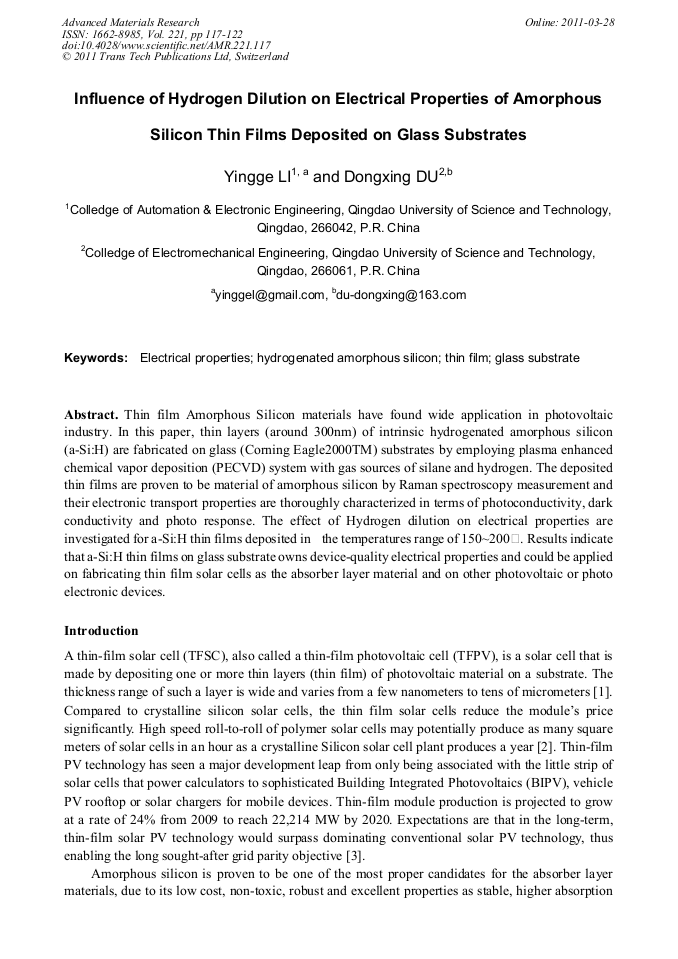
Thin film Amorphous Silicon materials have found wide application in photovoltaic industry. In this paper, thin layers (around 300nm) of intrinsic hydrogenated amorphous silicon (a-Si:H) are fabricated on glass (Corning Eagle2000TM) substrates by employing plasma enhanced chemical vapor deposition (PECVD) system with gas sources of silane and hydrogen. The deposited thin films are proven to be material of amorphous silicon by Raman spectroscopy measurement and their electronic transport properties are thoroughly characterized in terms of photoconductivity, dark conductivity and photo response. The effect of Hydrogen dilution on electrical properties are investigated for a-Si:H thin films deposited in the temperatures range of 150~200°C. Results indicate that a-Si:H thin films on glass substrate owns device-quality electrical properties and could be applied on fabricating thin film solar cells as the absorber layer material and on other photovoltaic or photo electronic devices.
You might also be interested in these eBooks

Info:

Periodical:

Pages:

117-122

Citation:

Online since:

March 2011

Export:

Price:

Permissions CCC:

Permissions PLS:

Сopyright:

© 2011 Trans Tech Publications Ltd. All Rights Reserved

Share:

Citation:

[1] Information on: http: /en. wikipedia. org/wiki/Thin_film_solar_cell.

Google Scholar

[2] Information on: http: /www. risoe. dk/Research/sustainable_energy/Solar_energy. aspx.

Google Scholar

[3] Information on: http: /www. renewableenergymagazine. com/paginas/Contenidosecciones. asp? ID=15&Cod=5767&Nombre=PV+solar.

Google Scholar

[4] R.E.I. Schropp and M. Zeman: New developments in amorphous thin-film silicon solar cells, IEEE Transactions on Electron Devices, Vol. 46, No. 10 (1999), p. (2086).

DOI: 10.1109/16.792001

Google Scholar

[5] J. Melskens, G. van Elzakker, Y. Li, M. Zeman. Analysis of hydrogenated amorphous silicon thin films and solar cells by means of Fourier Transform Photocurrent Spectroscopy, Thin Solid Films, vol. 516, No. 20 (2008), p.6877.

DOI: 10.1016/j.tsf.2007.12.049

Google Scholar

[6] C.R. Wronski, B. Von Roedern, A. Kołodziej, Thin film Si: H based solar cells, Vacuum, Vol. 82, No. 10 (2008), p.1145.

DOI: 10.1016/j.vacuum.2008.01.043

Google Scholar

[7] G. van Elzakker, F.D. Tichelaar, M. Zeman, Suppression of crystalline growth in silicon films deposited from hydrogen diluted silane using a layer-by-layer approach, Thin Solid Films, Vol. 515, No. 9 (2007), p.7460.

DOI: 10.1016/j.tsf.2006.11.114

Google Scholar

[8] B. Swatowska, T. Stapinski, Amorphous hydrogenated silicon-nitride films for applications in solar cells, Vacuum, vol. 82, No. 10 (2008), p.942.

DOI: 10.1016/j.vacuum.2008.01.004

Google Scholar

[9] Y. Li and D. Du, Characterization of low temperature Deposited Flexible Amorphous Silicon Solar Cells, Proceedings on 2009 international Conference on Energy and Environment Technology, Guilin, China (2009), p.548.

DOI: 10.1109/iceet.2009.139

Google Scholar

[10] Y. Li and D. Du, Characterization of Amorphous Silicon Thin Films Deposited on Upilex-s Polyimide Substrates for Application in Flexible Solar Cells, Advanced Material Research, vol. 87-88 (2010), p.416.

DOI: 10.4028/www.scientific.net/amr.87-88.416

Google Scholar

[11] T. Ruf, Phonon Raman Scattering in a semiconductors, Quantum wells and Superlattics, Springer (1998).

Google Scholar

[12] D. Schroder, Semiconductor material and device characterization, John Willey&Sons (1998).

Google Scholar

[13] B George, P. Mclntyre, Infrared Spectroscopy, John Wiley & Sons (1999).

Google Scholar

[14] J. Poortmans and V. Arkhipov, Thin film solar cells: fabrication, characterization and applications, John Wiley & Sons (2006), p.183.

DOI: 10.1002/0470091282

Google Scholar

[15] Information on http: /www. temptronic. com/products/TP03000. htm.

Google Scholar