Thermodynamic Study and Predicted Amorphization Composition Range of the Co-Ni-Ti Liquid Alloys

Article Preview

Abstract:

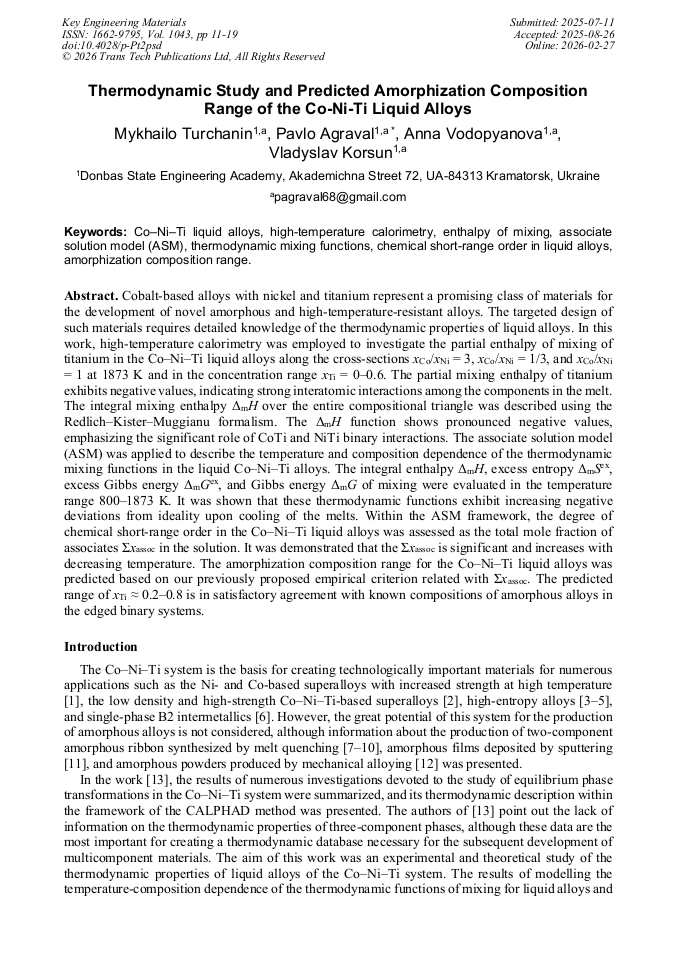
Cobalt-based alloys with nickel and titanium represent a promising class of materials for the development of novel amorphous and high-temperature-resistant alloys. The targeted design of such materials requires detailed knowledge of the thermodynamic properties of liquid alloys. In this work, high-temperature calorimetry was employed to investigate the partial enthalpy of mixing of titanium in the Co–Ni–Ti liquid alloys along the cross-sections xCo/xNi = 3, xCo/xNi = 1/3, and xCo/xNi = 1 at 1873 K and in the concentration range xTi = 0–0.6. The partial mixing enthalpy of titanium exhibits negative values, indicating strong interatomic interactions among the components in the melt. The integral mixing enthalpy ΔmH over the entire compositional triangle was described using the Redlich–Kister–Muggianu formalism. The ΔmH function shows pronounced negative values, emphasizing the significant role of CoTi and NiTi binary interactions. The associate solution model (ASM) was applied to describe the temperature and composition dependence of the thermodynamic mixing functions in the liquid Co–Ni–Ti alloys. The integral enthalpy ΔmH, excess entropy ΔmSex, excess Gibbs energy ΔmGex, and Gibbs energy ΔmG of mixing were evaluated in the temperature range 800–1873 K. It was shown that these thermodynamic functions exhibit increasing negative deviations from ideality upon cooling of the melts. Within the ASM framework, the degree of chemical short-range order in the Co–Ni–Ti liquid alloys was assessed as the total mole fraction of associates Σxassoc in the solution. It was demonstrated that the Σxassoc is significant and increases with decreasing temperature. The amorphization composition range for the Co–Ni–Ti liquid alloys was predicted based on our previously proposed empirical criterion related with Σxassoc. The predicted range of xTi ≈ 0.2–0.8 is in satisfactory agreement with known compositions of amorphous alloys in the edged binary systems.
You might also be interested in these eBooks

Info:

Periodical:

Pages:

11-19

Citation:

Online since:

February 2026

Export:

Price:

Permissions CCC:

Permissions PLS:

Сopyright:

© 2026 Trans Tech Publications Ltd. All Rights Reserved

Share:

Citation:

* - Corresponding Author

[1] R. C. Reed, The Superalloys: Fundamentals and Applications, Cambridge University Press, Cambridge, 2006.

Google Scholar

[2] C. Wang, J. Le, K. Chen, e.a., A novel Co–Ni–Ti–V-based superalloy exhibiting low density and high strength, Mater. Sci. Eng. A. 885 (2023), 145633.

DOI: 10.1016/j.msea.2023.145633

Google Scholar

[3] J. Yi, L. Yang, L. Wang, e.a., Novel, equimolar, multiphase CoCuNiTiV high-entropy alloy: phase component, microstructure, and compressive properties. Met. Mater. Int. 27 (2021) 2387–2394.

DOI: 10.1007/s12540-020-00923-2

Google Scholar

[4] H. Kang, Z. Xu, B. Wu, e.a., Phase stability and mechanical properties of the six-principal element TiVNbCrCoNi alloys. J. All. Compd. 993 (2024) 174661.

DOI: 10.1016/j.jallcom.2024.174661

Google Scholar

[5] O. Zatsarna, S. Kotrechko, O. Filatov, e.a., Phenomenon of ignition and explosion of high-entropy alloys of systems Ti–Zr–Hf–Ni–Cu, Ti–Zr–Hf–Ni–Cu–Co under quasi-static compression Fract. Struct. Integr. 18 No. 68 (2024) 410–421.

DOI: 10.3221/igf-esis.68.27

Google Scholar

[6] W. Zhao, H. Wang, Q. He, e.a., Formation of single-phased B2 multi-principal element intermetallics: From experiments to modeling. Scr. Mater. 256 (2025) 116437.

DOI: 10.1016/j.scriptamat.2024.116437

Google Scholar

[7] A. Inoue, K. Kobayashi, C. Suryanarayana, e.a., An amorphous phase in Co-rich Co–Ti alloys, Scr. Metal. 14 (1980) 119–123.

DOI: 10.1016/0036-9748(80)90137-4

Google Scholar

[8] K. Aoki, T. Masumoto, Proc. Inst. Meet. on Advanced Materials, Materials Research Society, Pittsburgh, PA. 3 (1989) 393–398.

Google Scholar

[9] R. Bormann, K. Zoelter, Determination of the Thermodynamic Functions and Calculation of Phase Diagrams for Metastable Phases, Phys. Stat. Sol. (a). 131 (1992 691–705.

DOI: 10.1002/pssa.2211310238

Google Scholar

[10] R. Bormann, Thermodynamics of undercooled liquids and its application to amorphous phase formation, Mater. Sci. Eng., A. 175 No. 1-2 (1994) 55–60.

DOI: 10.1016/0921-5093(94)90518-5

Google Scholar

[11] M.S. El-Eskandarany, W. Zhang, A. Inoue, Glass-forming ability and magnetic properties of mechanically solid-state reacted Co100–xTix alloy powders, J. Alloys Compd. 350 No. 1-2 (2003) 232–245.

DOI: 10.1016/s0925-8388(02)00929-5

Google Scholar

[12] D. Zhang, C. Zhao, J. Luo, e.a, Experimental Investigation of Fundamental Film Properties for Co1–xTix Alloying Films with Different Compositions (0≤ x ≤ 1), J. Mater. Sci. Mater. Electron. 31 No. 1 (2020) 105-114.

DOI: 10.1007/s10854-019-01378-x

Google Scholar

[13] C. Zhou, C. Guo, C. Li, e.a., Experimental determination and thermodynamic assessment of the Co–Ni–Ti system, CALPHAD. 63 (2018) 61-76.

DOI: 10.1016/j.calphad.2018.08.011

Google Scholar

[14] M. A. Turchanin and I. V. Nikolaenko, Enthalpies of formation of liquid (copper+ manganese) alloys, Metall and Materi Trans B. 28 (1997) 473–478.

DOI: 10.1007/s11663-997-0114-3

Google Scholar

[15] P. Agraval, M. Turchanin, L. Dreval, e.a., Mixing enthalpy of liquid Cu–Hf–Ni alloys at 1873 K, J. Therm. Anal. Calorim. 128 (2017) 1753–1763.

DOI: 10.1007/s10973-016-6060-z

Google Scholar

[16] P. Agraval, L. Dreval, M. Turchanin, e.a., Enthalpy of mixing of liquid Ni–Ti–Zr alloys at 1873K, J. Chem. Thermodyn. 106 (2017) 309–316.

DOI: 10.1016/j.jct.2016.11.008

Google Scholar

[17] SGTE Unary Database Version 5.0, https://www.sgte.net/en/.

Google Scholar

[18] A.F. Guillermet, Assessment of the thermodynamic properties of the Ni–Co system, Z. Metallkde. 78 No. 9 (1987) 639–647.

Google Scholar

[19] L. A. Dreval, P. G. Agraval, M. A. Turchanin, Calorimetric investigation of the mixing enthalpy of liquid Co–Cu–Ti alloys at 1873 K, Phys. Chem. Liq. 56 No. 5 (2018) 674–684.

DOI: 10.1080/00319104.2017.1376058

Google Scholar

[20] M. Turchanin, P. Agraval, L. Dreval, e.a., Calorimetric Investigation of the Mixing Enthalpy of Liquid Hf–Ni–Ti Alloys and Thermodynamic Properties and Chemical Ordering in Quaternary Liquid Cu–Hf–Ni–Ti Alloys, J. Phase Equilib. Diffus. 41 (2020) 469–490.

DOI: 10.1007/s11669-020-00806-4

Google Scholar

[21] M. Turchanin, P. Agraval, L. Dreval, e.a., Thermodynamics and Chemical Ordering of Liquid Cu–Hf–Ni–Ti–Zr Alloys, J. Phase Equilib. Diffus. 42 No. 5 (2021) 623–646.

DOI: 10.1007/s11669-021-00898-6

Google Scholar

[22] M.A. Turchanin, P.G. Agraval, A.A. Vodopyanova, e.a., Thermodynamic assessment of the Co–Ti system, J. Phase Equilib. Diffusion. Vol. 45 No. 3 (2024) 434–446.

DOI: 10.1007/s11669-024-01094-y

Google Scholar