The Interaction of the Components of the Injected Two-Phase Flow with Hot Metal during Injection Desulphurization in the Ladle

Article Preview

Abstract:

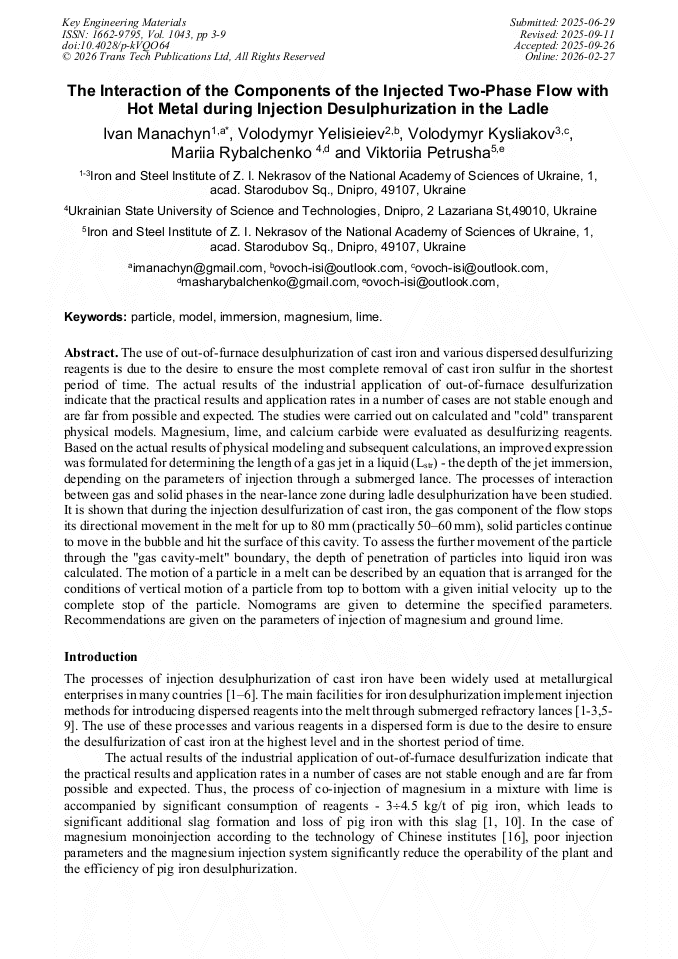
The use of out-of-furnace desulphurization of cast iron and various dispersed desulfurizing reagents is due to the desire to ensure the most complete removal of cast iron sulfur in the shortest period of time. The actual results of the industrial application of out-of-furnace desulfurization indicate that the practical results and application rates in a number of cases are not stable enough and are far from possible and expected. The studies were carried out on calculated and "cold" transparent physical models. Magnesium, lime, and calcium carbide were evaluated as desulfurizing reagents. Based on the actual results of physical modeling and subsequent calculations, an improved expression was formulated for determining the length of a gas jet in a liquid (Lstr ) - the depth of the jet immersion, depending on the parameters of injection through a submerged lance. The processes of interaction between gas and solid phases in the near-lance zone during ladle desulphurization have been studied. It is shown that during the injection desulfurization of cast iron, the gas component of the flow stops its directional movement in the melt for up to 80 mm (practically 50–60 mm), solid particles continue to move in the bubble and hit the surface of this cavity. To assess the further movement of the particle through the "gas cavity-melt" boundary, the depth of penetration of particles into liquid iron was calculated. The motion of a particle in a melt can be described by an equation that is arranged for the conditions of vertical motion of a particle from top to bottom with a given initial velocity up to the complete stop of the particle. Nomograms are given to determine the specified parameters. Recommendations are given on the parameters of injection of magnesium and ground lime.
You might also be interested in these eBooks

Info:

Periodical:

Pages:

3-9

Citation:

Online since:

February 2026

Export:

Price:

Permissions CCC:

Permissions PLS:

Сopyright:

© 2026 Trans Tech Publications Ltd. All Rights Reserved

Share:

Citation:

* - Corresponding Author

[1] Voronova, N. A. (1983). Desulfurization of Hot Metal by Magnesium; Publisher. Iron & Steel Society; Publication date. January 1, 1983. [in Russian]

Google Scholar

[2] Robey, R., Whitehead, М. (2014). Out-of-blast processing of cast iron, taking into account specific production conditions. MPT International, 1, 16-24 [in Russian].

Google Scholar

[3] Molchanov, L., Nizyaev, K., Boychenko, B., Stoyanov, A., Synehin, Ye. (2013). Ladle desulphurization of liquid iron in context of the tasks of national industry. New Materials and Technologies in Metallurgy and Mechanical Engineering, 2, 38-41 [in Ukrainian].

Google Scholar

[4] A. M. Zborshchik, S. V. Kuberskii, K. E. Pismarev, V. V. Akulov & G. Ya. Dovgalyuk (2010). Comparison of ladle technologies for hot-metal desulfurization. Steel Transl., 40, 35–37

DOI: 10.3103/S0967091210010092

Google Scholar

[5] A. F. Shevchenko, A. M. Bashmakov, A. S. Vergun, I. A. Manachin, V. G. Kislyakov, É. A. Trotsenko, Liu Dong Yie & Yang Jia Rui. (2019). Modern High-Performance Complexes of Extra-Deep Desulphurization of Cast iron by Mono-Injection of Magnesium. Metallurgist, 62, 965–973.

DOI: 10.1007/s11015-019-00734-w

Google Scholar

[6] Tovarovskii, I. G. (2014). Influence of blast-furnace parameters on coke consumption and productivity. Steel Transl., 44, 350–358.

DOI: 10.3103/S0967091214050155

Google Scholar

[7] Vergun, A. S., Shevchenko, A. F., Kislyakov, V. G., Molchanov, L. S., Dvoskin, B. V. (2019). Sulphur and gas removal from hot metal by injecting disperse magnesium in a gas jet. Steel in translation, 49(1), 45-49

DOI: 10.3103/S0967091219010133

Google Scholar

[8] Lindström, D., Nortier, P., Sichen, D. (2014). Functions of Mg and Mg–CaO Mixtures in Hot Metal Desulfurization. Steel Research International, 85 (1), 76–88.

DOI: 10.1002/srin.201300071

Google Scholar

[9] Shevchenko, Manachin I.A., Vergun A.S., Dvoskin B.V., Kislyakov V.G., Shevchenko S.A., Ostapenko A.V. (2017). Out-of-furnace desulphurisation of cast iron in ladles. Technology, research, analysis, improvement. Publisher. Dnipro-VAL; Publication date. Jule 25, 2017; ISBN 978-966-8704-75-8 [in Russian].

Google Scholar

[10] Rudenko, A. L. (2014). The analysis of patterns of interphase sulfur distribution in the injection treatment of iron with magnesium. Izvestiya. Ferrous Metallurgy, 57(8), 13-18. https://doi.org/10.17073/0368-0797-2014-8-13-18 [in Russian].

DOI: 10.17073/0368-0797-2014-8-13-18

Google Scholar

[11] Rudenko, A. L. (2016). Kinetics of interfacial transition of sulfur during ladle refining of iron by magnesium. Izvestiya. Ferrous Metallurgy, 59(12), 896-902. ). [in Russian].

DOI: 10.17073/0368-0797-2016-12-896-902

Google Scholar

[12] Frank Nicolaas Hermanus Schrama, Elisabeth Maria Beunder, Bart Van den Berg, Yongxiang Yang & Rob Boom (2017). Sulphur removal in hot metalmaking and oxygen steelmaking. Hot metalmaking & Steelmaking, 44(5), 333-343. https://doi.org/10.1080/03019233. 2017.1303914.

DOI: 10.1080/03019233.2017.1303914

Google Scholar

[13] A. M. Zborshchik, S. V. Kuberskii, G. Ya. Dovgalyuk & K. V. Vinnik. (2011). Effectiveness of fluidized lime in the desulfurization of hot metal in 300-t casting ladles. Steel Transl., 41, 741–744

DOI: 10.3103/S096709121109021X

Google Scholar

[14] Zborshchik, A. M., Kuberskii, S. V., Dovgalyuk, G. Y. & V.N. Belomerya. The Efficiency of Using Fluidized Lime for Desulfurization of Iron in 300-Ton Charging Ladles. Scientific papers of Donetsk National Technical University. Series: Metallurgy, 13(194), 53-60. https://ea.donntu.edu.ua:8080/jspui/handle/123456789/14635

DOI: 10.3103/s096709121109021x

Google Scholar