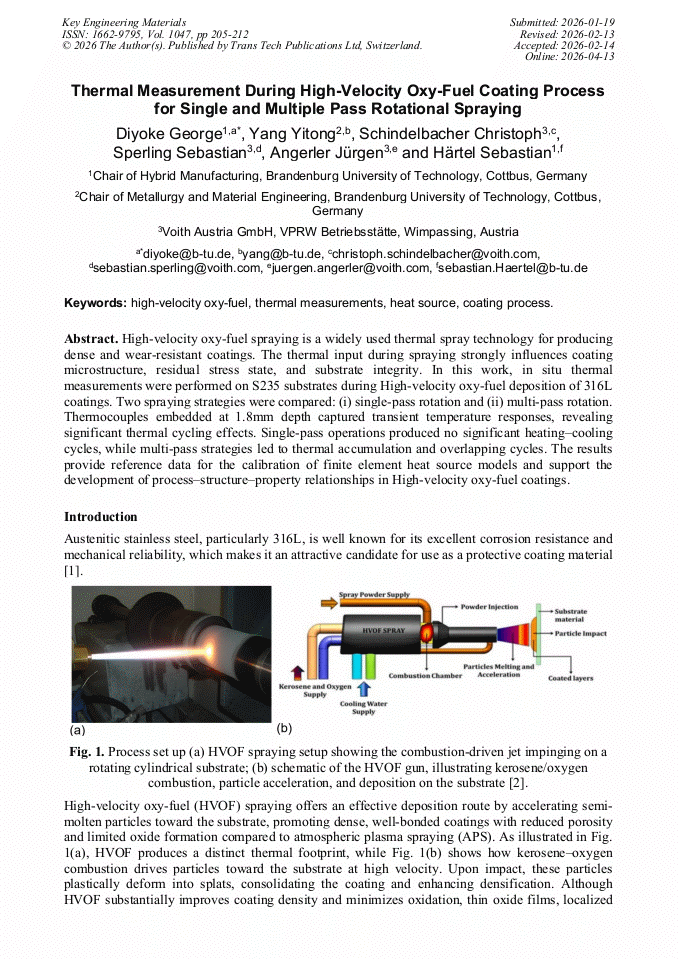
[1]
Y.B. Lei, Z.B. Wang, B. Zhang, Z.P. Luo, J. Lu, K. Lu, Enhanced mechanical properties and corrosion resistance of 316L stainless steel by pre-forming a gradient nanostructured surface layer and annealing, Acta Mater. 208 (2021) 116773.
DOI: 10.1016/j.actamat.2021.116773
Google Scholar
[2]
S. Kumar, D.C. Prasad, H. Hanumanthappa, Role of Thermal Spray Coatings on Erosion, Corrosion, and Oxidation in Various Applications: A Review, J. Bio-Tribo-Corros. 10 (2024) 22.
DOI: 10.1007/s40735-024-00822-8
Google Scholar
[3]
S. Kuroda, T. Fukushima, M. Sasaki, T. Kodama, Microstructure and Corrosion Resistance of HVOF Sprayed 316L Stainless Steel and Hastelloy C Coatings, Mater. Trans. 43 (2002) 3177–3183.
DOI: 10.2320/matertrans.43.3177
Google Scholar
[4]
A. Valarezo, K. Shinoda, S. Sampath, Effect of deposition rate and deposition temperature on residual stress of HVOF-sprayed coatings, J. Therm. Spray Technol. 29 (6) (2020) 1322–1338.
DOI: 10.1007/s11666-020-01073-y
Google Scholar
[5]
S. Sampath, X. Jiang, J. Matejicek, A. Leger, A. Vardelle, Substrate temperature effects on splat formation, microstructure development and properties of plasma sprayed coatings Part I: Case study for partially stabilized zirconia, Mater. Sci. Eng. A 272 (1) (1999) 181–188.
DOI: 10.1016/s0921-5093(99)00459-1
Google Scholar
[6]
K. Shinoda, Y. Kojima, T. Yoshida, In situ measurement system for deformation and solidification phenomena of yttria-stabilized zirconia droplets impinging on quartz glass substrate under plasma-spraying conditions, J. Therm. Spray Technol. 46 (2005) 98.
DOI: 10.1361/105996305x76531
Google Scholar
[7]
K.-C. Chang, C.-M. Chen, Revisiting heat transfer analysis for rapid solidification of metal droplets, Int. J. Heat Mass Transf. 44 (8) (2001) 1573–1583.
DOI: 10.1016/S0017-9310(00)00193-9
Google Scholar
[8]
S. Chandra, P. Fauchais, Formation of solid splats during thermal spray deposition, J. Therm. Spray Technol. 18 (2009) 148–180.
DOI: 10.1007/s11666-009-9294-5
Google Scholar
[9]
A. Fardan, R. Ahmed, Modeling the evolution of residual stresses in thermally sprayed YSZ coating on stainless steel substrate, J. Therm. Spray Technol. 28 (4) (2019) 717–736.
DOI: 10.1007/s11666-019-00856-2
Google Scholar
[10]
P. Bansal, P.H. Shipway, S.B. Leen, Residual stresses in high-velocity oxy-fuel thermally sprayed coatings – Modelling the effect of particle velocity and temperature during the spraying process, Acta Mater. 55 (15) (2007) 5089–5101
DOI: 10.1016/j.actamat.2007.05.031
Google Scholar
[11]
Goldak, J., Chakravarti, A., & Bibby, M. (1984). A new finite element model for welding heat sources. Metallurgical Transactions B, 15(2), 299–305.
DOI: 10.1007/bf02667333
Google Scholar
[12]
Zhang, X., Li, S., & Kovacevic, R. (2005). Finite element modeling of heat transfer in laser-based surface engineering processes. International Journal of Machine Tools and Manufacture, 45(10), 1135–1145.
Google Scholar
[13]
S. Haertel, A. Schmidt, J. Szyndler, Determination of welding heat source parameters for FEM simulation based on temperature history and real bead shape, in: Proceedings, (2023) 159–168.
DOI: 10.21741/9781644902479-18
Google Scholar