p.77
p.85
p.91
p.99
p.105
p.111
p.117
p.123
p.129
Elevated Temperature Mechanical Properties of Harmonic Structure Designed AlCoCrFeNi High Entropy Alloy by MM/SPS Process

Abstract:
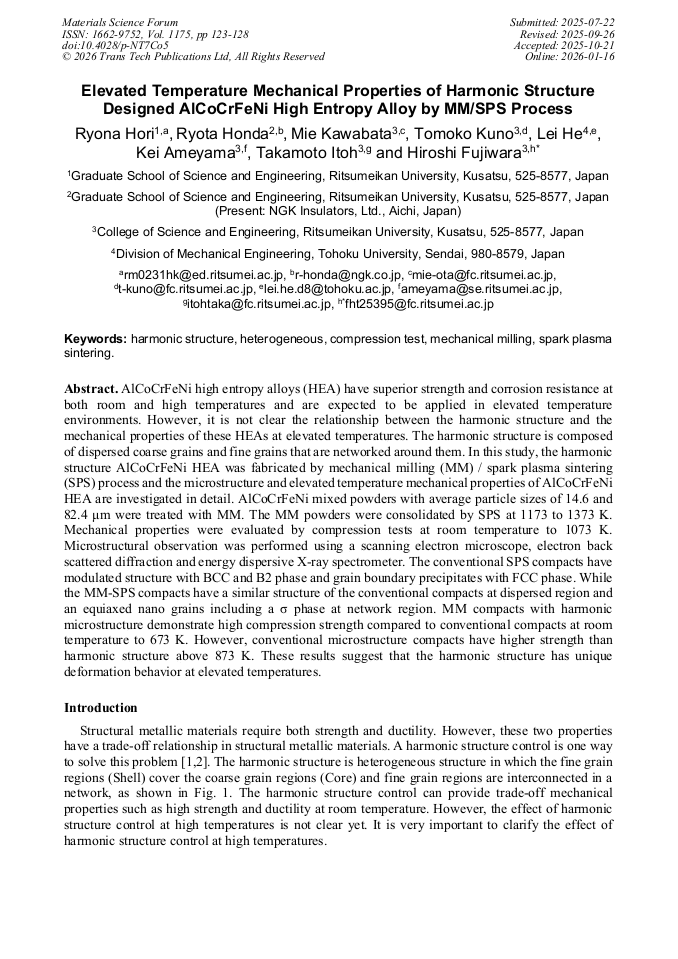
AlCoCrFeNi high entropy alloys (HEA) have superior strength and corrosion resistance at both room and high temperatures and are expected to application in elevated temperature environments. However, it is not clear the relationship between the harmonic structure and the mechanical properties of these HEAs at elevated temperatures. The harmonic structure is composed of dispersed coarse grains and fine grains that are networked around them. In this study, the harmonic structure AlCoCrFeNi HEA was fabricated by mechanical milling (MM) / spark plasma sintering (SPS) process and the microstructure and elevated temperature mechanical properties of AlCoCrFeNi HEA are investigated in detail. AlCoCrFeNi mixed powders with average particle sizes of 14.6 and 82.4 μm were treated with MM. The MM powders were consolidated by SPS at 1173 to 1373 K. Mechanical properties were evaluated by compression tests at room temperature to 1073 K. Microstructural observation was performed using a scanning electron microscope, electron back scattered diffraction and energy dispersive X-ray spectrometer. The conventional SPS compacts have modulated structure with BCC and B2 phase and grain boundary precipitates with FCC phase. While the MM-SPS compacts have a similar structure of the conventional compacts at dispersed region and an equiaxed nanograins including a σ phase at network region. MM compacts with harmonic microstructure demonstrate high compression strength compared to conventional compacts at room temperature to 673 K. However, conventional microstructure compacts have higher strength than harmonic structure above 873 K. These results suggest that the harmonic structure has unique deformation behavior at elevated temperatures.
Info:
Periodical:
Pages:
123-128
DOI:
Citation:
Online since:
January 2026
Authors:
Price:
Сopyright:
© 2026 Trans Tech Publications Ltd. All Rights Reserved
Share:
Citation: