Quasi-Atomic Nickel Hydroxides Loaded on Graphitic Carbon Nitride for Enhanced Light-Driven Catalysis

Article Preview

Abstract:

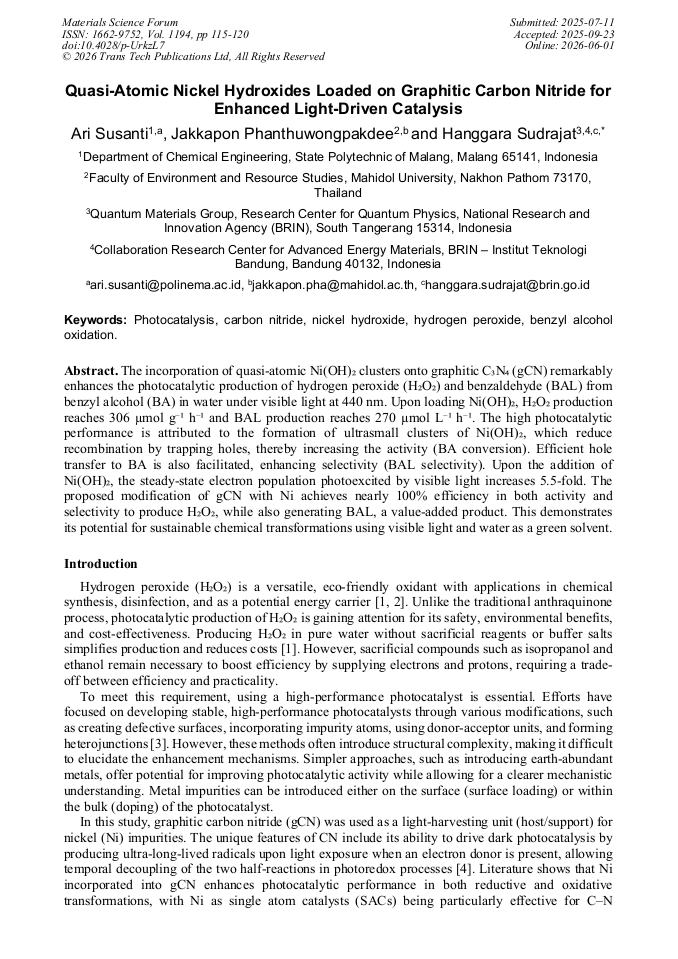
The incorporation of quasi-atomic Ni (OH)₂ clusters onto graphitic C₃N₄ (gCN) remarkably enhances the photocatalytic production of hydrogen peroxide (H₂O₂) and benzaldehyde (BAL) from benzyl alcohol (BA) in water under visible light at 440 nm. Upon loading Ni (OH)₂, H₂O₂ production reaches 306 µmol g⁻¹ h⁻¹ and BAL production reaches 270 µmol L⁻¹ h⁻¹. The high photocatalytic performance is attributed to the formation of ultrasmall clusters of Ni (OH)₂, which reduce recombination by trapping holes, thereby increasing the activity (BA conversion). Efficient hole transfer to BA is also facilitated, enhancing selectivity (BAL selectivity). Upon the addition of Ni (OH)₂, the steady-state electron population photoexcited by visible light increases 5.5-fold. The proposed modification of gCN with Ni achieves nearly 100% efficiency in both activity and selectivity to produce H₂O₂, while also generating BAL, a value-added product. This demonstrates its potential for sustainable chemical transformations using visible light and water as a green solvent.
You might also be interested in these eBooks

Info:

Periodical:

Materials Science Forum (Volume 1194)

Pages:

115-120

Citation:

Online since:

June 2026

Export:

Price:

Permissions CCC:

Permissions PLS:

Сopyright:

© 2026 Trans Tech Publications Ltd. All Rights Reserved

Share:

Citation:

* - Corresponding Author

[1] S. Wu, X. Quan, Design principles and strategies of photocatalytic H2O2 production from O2 reduction, ACS ES&T Eng., 2 (2022) 1068-1079.

Google Scholar

[2] Z. Chen, D. Yao, C. Chu, S. Mao, Photocatalytic H2O2 production systems: design strategies and environmental applications, Chem. Eng. J., 451 (2023) 138489.

DOI: 10.1016/j.cej.2022.138489

Google Scholar

[3] H. Hou, X. Zeng, X. Zhang, Production of hydrogen peroxide by photocatalytic processes, Angew. Chem., Int. Ed., 59 (2020) 17356-17376.

DOI: 10.1002/anie.201911609

Google Scholar

[4] V.W.h. Lau, D. Klose, H. Kasap, F. Podjaski, M.C. Pignié, E. Reisner, G. Jeschke, B.V. Lotsch, Dark photocatalysis: storage of solar energy in carbon nitride for time‐delayed hydrogen generation, Angew. Chem., Int. Ed., 129 (2017) 525-529.

DOI: 10.1002/ange.201608553

Google Scholar

[5] M. Kwak, J. Bok, B.-H. Lee, J. Kim, Y. Seo, S. Kim, H. Choi, W. Ko, W.H. Antink, C.W. Lee, Ni single atoms on carbon nitride for visible-light-promoted full heterogeneous dual catalysis, Chem. Sci., 13 (2022) 8536-8542.

DOI: 10.1039/d2sc02174a

Google Scholar

[6] X. Jin, R. Wang, L. Zhang, R. Si, M. Shen, M. Wang, J. Tian, J. Shi, Electron configuration modulation of nickel single atoms for elevated photocatalytic hydrogen evolution, Angew. Chem., Int. Ed., 132 (2020) 6894-6898.

DOI: 10.1002/ange.201914565

Google Scholar

[7] X. Zhang, H. Su, P. Cui, Y. Cao, Z. Teng, Q. Zhang, Y. Wang, Y. Feng, R. Feng, J. Hou, Developing Ni single-atom sites in carbon nitride for efficient photocatalytic H2O2 production, Nat. Commun., 14 (2023) 7115.

DOI: 10.1038/s41467-023-42887-y

Google Scholar

[8] H. Sudrajat, S. Hartuti, Boosting electron population in δ-Bi2O3 through iron doping for improved photocatalytic activity, Adv. Powder Technol., 30 (2019) 983-991.

DOI: 10.1016/j.apt.2019.02.012

Google Scholar

[9] L. Xie, J.-G. Hao, H.-Q. Chen, Z.-X. Li, S.-Y. Ge, Y. Mi, K. Yang, K.-Q. Lu, Recent advances of nickel hydroxide-based cocatalysts in heterogeneous photocatalysis, Catal. Commun., 162 (2022) 106371.

DOI: 10.1016/j.catcom.2021.106371

Google Scholar