Multi–Objective Optimization of Flame Scarfing Parameters in Low-Carbon Steel Slabs for Enhanced Process Performance

Article Preview

Abstract:

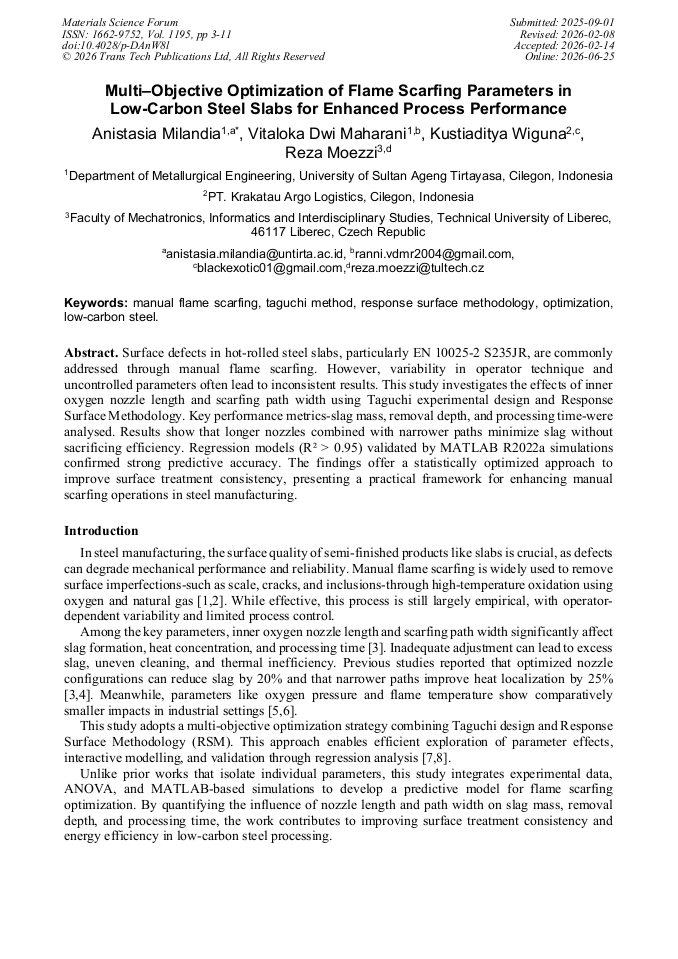
Surface defects in hot-rolled steel slabs, particularly EN 10025-2 S235JR, are commonly addressed through manual flame scarfing. However, variability in operator technique and uncontrolled parameters often lead to inconsistent results. This study investigates the effects of inner oxygen nozzle length and scarfing path width using Taguchi experimental design and Response Surface Methodology. Key performance metrics—slag mass, removal depth, and processing time—were analysed. Results show that longer nozzles combined with narrower paths minimize slag without sacrificing efficiency. Regression models (R² > 0.95) validated by MATLAB simulations confirmed strong predictive accuracy. The findings offer a statistically optimized approach to improve surface treatment consistency, presenting a practical framework for enhancing manual scarfing operations in steel manufacturing.

You might also be interested in these eBooks

Info:

Periodical:

Materials Science Forum (Volume 1195)

Pages:

3-11

Citation:

Online since:

June 2026

Export:

Price:

Permissions CCC:

Permissions PLS:

Сopyright:

© 2026 Trans Tech Publications Ltd. All Rights Reserved

Share:

Citation:

* - Corresponding Author

[1] Zhang H, Li Y, Wang M. Thermo-chemical surface cleaning in steel manufacturing. J Mater Process Technol. 2022;301:117472.

Google Scholar

[2] Guo J, Chen X, Liu D. Thermodynamics of flame scarfing in carbon steel. Iron Steel Technol. 2020;17(5):41–7.

Google Scholar

[3] ASTM International. A6/A6M-19. General Requirements for Structural Steel Products. 2019.

Google Scholar

[4] EN 10025-2. Hot rolled products of structural steels – Technical delivery conditions. 2019.

Google Scholar

[5] Liu Z, Huang J, Sun Y. Optimization of flame surface cleaning using oxygen nozzle control. J Iron Steel Res Int. 2021;28(11):1182–91.

Google Scholar

[6] Kou S. Welding Metallurgy. 2nd ed. Wiley; 2003.

Google Scholar

[7] Li C, Li X, Lu Y. Simulation of slag behavior and heat transfer in flame cleaning. Steel Res Int. 2019;90(4):1800522.

Google Scholar

[8] Park D, Lee K. Variability and standardization in manual flame scarfing. J Mater Eng Perform. 2020;29(3):1870–81.

Google Scholar

[9] Behrouzi M, Mahmoudi AH. Torch configuration and slag control in scarfing. Metall Mater Trans B. 2019;50(3):1024–32.

Google Scholar

[10] Kim J, Lee S. Scarfing path width optimization and heat efficiency. Steel Res Int. 2018;89(10):1700475.

Google Scholar

[11] Montgomery DC. Design and Analysis of Experiments. 8th ed. Wiley; 2017.

Google Scholar

[12] Box GEP, Wilson KB. On the experimental attainment of optimum conditions. J R Stat Soc Ser B. 1951;13(1):1–45.

Google Scholar

[13] Wibowo S, Sulaiman S, Nukman Y. Application of Taguchi method in thermal processing. Appl Mech Mater. 2015;761:187–91.

Google Scholar

[14] Zhang L, Wang X. Taguchi-RSM in gas-thermal manufacturing optimization. J Therm Process Eng. 2021;45(2):187–96.

Google Scholar

[15] MathWorks. MATLAB R2022a: Curve Fitting Toolbox Documentation.

Google Scholar

[16] Myers RH, Montgomery DC, Anderson-Cook CM. Response Surface Methodology. 4th ed. Wiley; 2016.

Google Scholar

[17] S. Lee, Y. Lee, B. Park, and C. Lee. Structural Optimization of Scarfing Machine with Acceleration Profile and Multi-Objective Genetic Algorithm Approach. Machines 2024;12(6):398.

DOI: 10.3390/machines12060398

Google Scholar