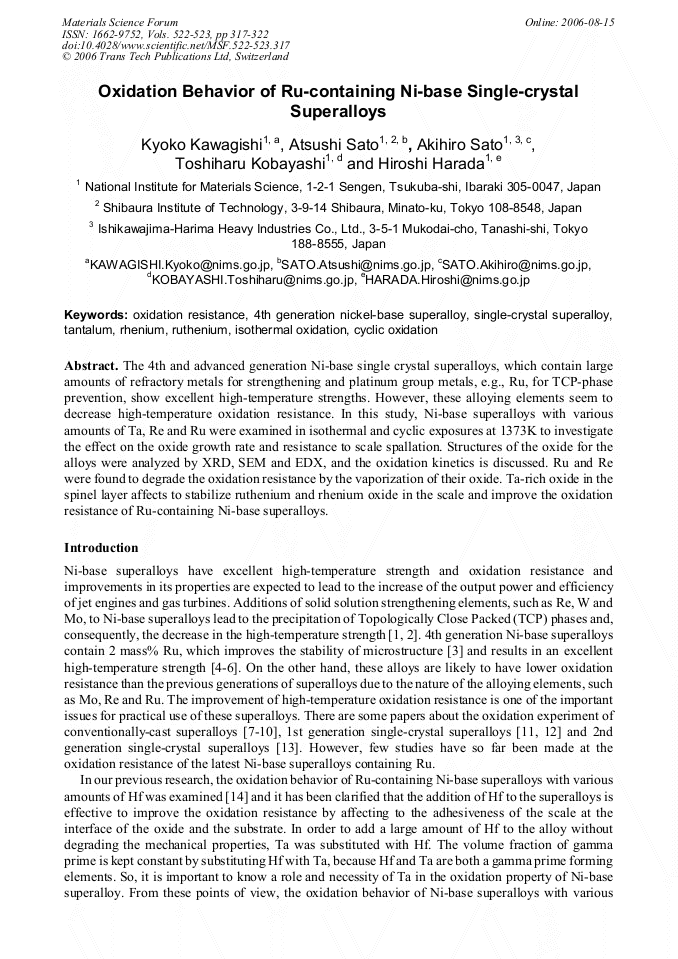
Oxidation Behavior of Ru-Containing Ni-Base Single-Crystal Superalloys

Article Preview

Abstract:

The 4th and advanced generation Ni-base single crystal superalloys, which contain large amounts of refractory metals for strengthening and platinum group metals, e.g., Ru, for TCP-phase prevention, show excellent high-temperature strengths. However, these alloying elements seem to decrease high-temperature oxidation resistance. In this study, Ni-base superalloys with various amounts of Ta, Re and Ru were examined in isothermal and cyclic exposures at 1373K to investigate the effect on the oxide growth rate and resistance to scale spallation. Structures of the oxide for the alloys were analyzed by XRD, SEM and EDX, and the oxidation kinetics is discussed. Ru and Re were found to degrade the oxidation resistance by the vaporization of their oxide. Ta-rich oxide in the spinel layer affects to stabilize ruthenium and rhenium oxide in the scale and improve the oxidation resistance of Ru-containing Ni-base superalloys.
You might also be interested in these eBooks

Info:

Periodical:

Materials Science Forum (Volumes 522-523)

Pages:

317-322

Citation:

Online since:

August 2006

Export:

Price:

Permissions CCC:

Permissions PLS:

Сopyright:

© 2006 Trans Tech Publications Ltd. All Rights Reserved

Share:

Citation:

[1] R. Darolia, D. F. Lahrman and R. D. Field: Superalloys 1988 (The Minerals, Metals & Materials Society, USA 1988) p.255.

Google Scholar

[2] T. Hino, T. Kobayashi, Y. Koizumi, H. Harada and T. Yamagata: Superalloys 2000 (The Minerals, Metals & Materials Society, USA 2000) p.729.

Google Scholar

[3] A. Sato, Y. Koizumi, T. Kobayashi, T. Yokokawa, H. Harada and H. Imai: J. Japan Inst. Met. Vol. 68 (2004), p.507.

Google Scholar

[4] Y. Koizumi, T. Kobayashi, T. Yokokawa, H. Harada, Y. Aoki, M. Arai, S. Masaki and K. Chikugo: Proc. 2nd International Symposium on High Temperature Materials 2001 (2001), p.30.

Google Scholar

[5] Y. Koizumi, T. Kobayashi, T. Yokokawa, H. Harada, Y. Aoki, M. Arai, S. Masaki and K. Chikugo: submitted to Mat. Sci. Eng. A.

Google Scholar

[6] J. X. Zhang, T. Murakumo, Y. Koizumi, T. Kobayashi, H. Harada and S. Masaki Jr.: Metall. Mater. Trans. A Vol. 33 (2002), p.3741.

Google Scholar

[7] S. Seal, S. C. Kuiry and L. A. Bracho: Oxid. Met. Vol. 56 (2001), p.581.

Google Scholar

[8] S. Seal, S. C. Kuiry and L. A. Bracho: Oxid. Met. Vol. 57 (2002), p.297.

Google Scholar

[9] S. Shinharoy and L. Narasimhan: Superalloys 2004 (The Minerals, Metals & Materials Society, USA 2004), p.623.

Google Scholar

[10] B. Wang, C. Sun, J. Gong, R. Huang and L. Wen: Corros. Sci. Vol. 46 (2004), P. 519.

Google Scholar

[11] M. H. Li, X. F. Sun, J. G. Li, Z. Y. Zhang, T. Jin, H. R. Guan and Z. Q. Hu: Oxid. Met. Vol. 59 (2003), p.591.

Google Scholar

[12] M. H. Li, X. F. Sun, T. Jin, H. R. Guan and Z. Q. Hu: Oxid. Met. Vol. 60 (2003), p.195.

Google Scholar

[13] K. Onal, M. C. Maris-Sida, G. H. Meier and F. S. Pettit: Superalloys 2004 (The Minerals, Metals & Materials Society, USA 2004), p.607.

Google Scholar

[14] K. Kawagishi, A. Sato, T. Kobayashi and H. Harada: Submitted to TMS Lett.

Google Scholar