Nano-Structuring of 316L Type Steel by Severe Plastic Deformation Processing Using Two-Dimensional Linear Plane Strain Machining

Article Preview

Abstract:

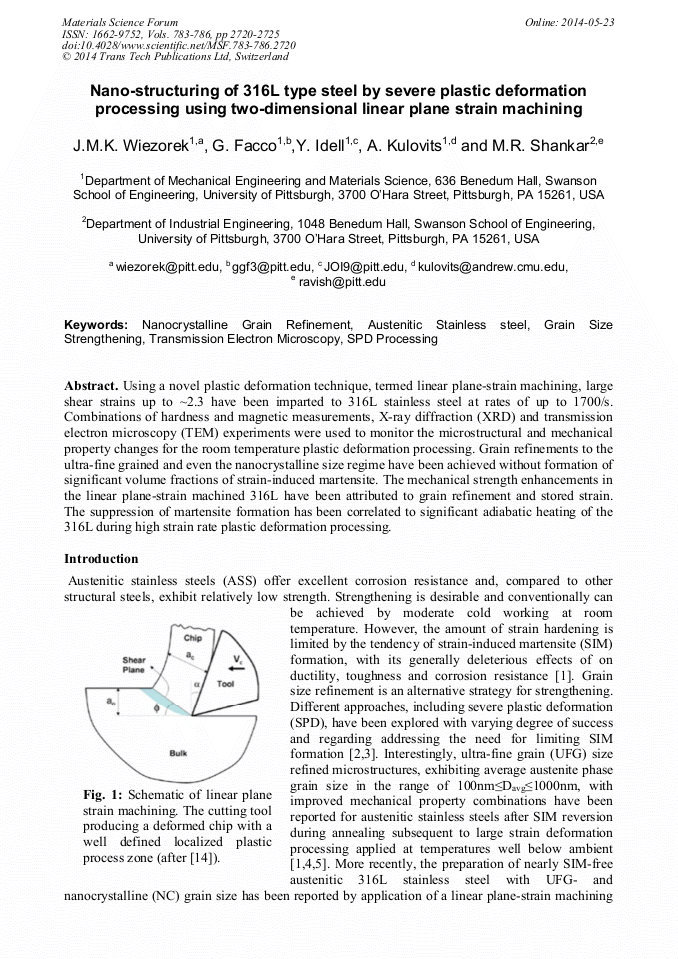
Using a novel plastic deformation technique, termed linear plane-strain machining, large shear strains up to ~2.3 have been imparted to 316L stainless steel at rates of up to 1700/s. Combinations of hardness and magnetic measurements, X-ray diffraction (XRD) and transmission electron microscopy (TEM) experiments were used to monitor the microstructural and mechanical property changes for the room temperature plastic deformation processing. Grain refinements to the ultra-fine grained and even the nanocrystalline size regime have been achieved without formation of significant volume fractions of strain-induced martensite. The mechanical strength enhancements in the linear plane-strain machined 316L have been attributed to grain refinement and stored strain. The suppression of martensite formation has been correlated to significant adiabatic heating of the 316L during high strain rate plastic deformation processing.
You might also be interested in these eBooks

Info:

Periodical:

Materials Science Forum (Volumes 783-786)

Pages:

2720-2725

Citation:

Online since:

May 2014

Export:

Price:

Permissions CCC:

Permissions PLS:

Сopyright:

© 2014 Trans Tech Publications Ltd. All Rights Reserved

Share:

Citation:

* - Corresponding Author

[1] M. Eskandari, A. Najafizadeh, A. Kermanpur, Mater. Sci. Eng. A 519 (2009) 46.

Google Scholar

[2] X.H. Chen, J. Lu, L. Lu, K. Lu, Scripta Mater. 52 (2005) 1039.

Google Scholar

[3] Z. Pakiela, M. Sus-Ryszkowska, A. Druzycka-Wiencek, K.J. Kurzydlowski, Seventh International Conference on Nanostructured Materials, Germany, 2004, p.20.

Google Scholar

[4] A.F. Padilha, P.R. Rios, ISIJ Int. 42 (2002) 325.

Google Scholar

[5] T. Angel, J. Iron Steel Inst. 177 (1954) 165.

Google Scholar

[6] Y. Idell, G. Facco, A. Kulovits, M.R. Shankar, J.M.K. Wiezorek, Scripta Mater. 68 (2013) 667.

Google Scholar

[7] S. Swaminathan, M. Ravi Shankar, B.C. Rao, W.D. Compton, S. Chandrasekar, A.H. King, K.P. Trumble, J. Mater. Sci. 42 (2007) 1529.

DOI: 10.1007/s10853-006-0745-9

Google Scholar

[8] S. Lee, J. Hwang, M.R. Shankar, S. Chandrasekar, W. Dale Compton, Metall. Mater. Trans. A 37 (2006) 1633.

Google Scholar

[9] J. Portillo, E.F. Rauch, S. Nicolopoulos, M. Gemmi, D. Bultreys, Mater. Sci. Forum 644 (2010) 1.

Google Scholar

[10] S. Abolghasem, S. Basu, S. Shekhar, J. Cai, M.R. Shankar, Acta Materialia 60 (2012) 376.

DOI: 10.1016/j.actamat.2011.09.055

Google Scholar

[11] D. Umbrello, R. M'Saoubi, J.C. Outeiro, International Journal of Machine Tools and Manufacture 47 (2007) 462.

Google Scholar

[12] G.R.C. Johnson, A Constitutive model and data for metals subjected to large strains and high strain rates and high temperatures, 7th International Symposium on Ballistics (1983) p.541.

Google Scholar

[13] A.H. Adibi-Sedeh, V. Madhavan, B. Bahr, Journal of Manufacturing Science and Engineering, Trans. ASME 125 (2003) 656.

Google Scholar

[14] H. Chandrasekaran, R. M'Saoubi, H. Chazal, Machining Science and Technology 9 (2005) 131.

Google Scholar

[15] B.D. Cullity, S.R. Stock, Elements of x-ray diffraction: Prentice Hall, (2001).

Google Scholar

[16] B.P. Kashyap, K. Tangri, Acta Metall. Mater. 11 (1995) 3971.

Google Scholar

[17] This work received support from the Nuclear Regulatory Commission, NRC-38-009-935.

Google Scholar