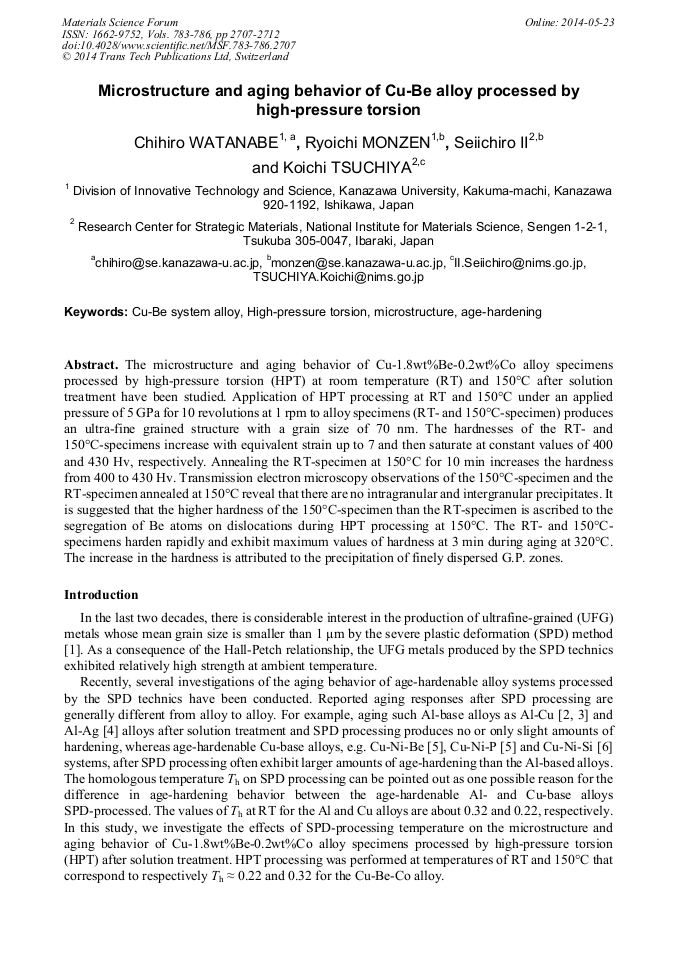
Microstructure and Aging Behavior of Cu-Be Alloy Processed by High-Pressure Torsion

Article Preview

Abstract:

The microstructure and aging behavior of Cu-1.8wt%Be-0.2wt%Co alloy specimens processed by high-pressure torsion (HPT) at room temperature (RT) and 150°C after solution treatment have been studied. Application of HPT processing at RT and 150°C under an applied pressure of 5 GPa for 10 revolutions at 1 rpm to alloy specimens (RT-and 150°C-specimen) produces an ultra-fine grained structure with a grain size of 70 nm. The hardnesses of the RT-and 150°C-specimens increase with equivalent strain up to 7 and then saturate at constant values of 400 and 430 Hv, respectively. Annealing the RT-specimen at 150°C for 10 min increases the hardness from 400 to 430 Hv. Transmission electron microscopy observations of the 150°C-specimen and the RT-specimen annealed at 150°C reveal that there are no intragranular and intergranular precipitates. It is suggested that the higher hardness of the 150°C-specimen than the RT-specimen is ascribed to the segregation of Be atoms on dislocations during HPT processing at 150°C. The RT-and 150°C-specimens harden rapidly and exhibit maximum values of hardness at 3 min during aging at 320°C. The increase in the hardness is attributed to the precipitation of finely dispersed G.P. zones.
You might also be interested in these eBooks

Info:

Periodical:

Materials Science Forum (Volumes 783-786)

Pages:

2707-2712

Citation:

Online since:

May 2014

Export:

Price:

Permissions CCC:

Permissions PLS:

Сopyright:

© 2014 Trans Tech Publications Ltd. All Rights Reserved

Share:

Citation:

* - Corresponding Author

[1] R. Z. Valiev, R. K. Islamgaliev, I. V. Alexandrov, Prog. Mater. Sci. 45 (2000) 103-189.

Google Scholar

[2] N. Tsuji, T. Iwata, M. Sato, S. Fujimoto and Y. Minamino, Sci. Tech of Adv. Mater. 5 (2004) 173-180.

Google Scholar

[3] Y. Huang, J. D. Robson and P. B. Prangnell, Acta Mater. 58 (2010) 1643-1657.

Google Scholar

[4] K. Ohashi, T. Fujita, K. Kaneko, Z. Horita and T. G. Langdon, Mater . Sci. Eng. A437 (2006) 240-247.

Google Scholar

[5] R. Monzen, Y. Takagawa, C. Watanabe, D. Terada and N. Tsuji, Procedia Eng. 10 (2011) 2417-2422.

DOI: 10.1016/j.proeng.2011.04.398

Google Scholar

[6] Y. Takagawa, Y. Tsujiuchi, C. Watanabe, R. Monzen and N. Tsuji, Mater. Trans. 54 (2013) 1-8.

Google Scholar

[7] T. Kunieda, M. Nakai, Y. Murata, T. Koyama and M. Morinaga, ISIJ Int. 45 (2005) 1909-(1914).

DOI: 10.2355/isijinternational.45.1909

Google Scholar

[8] S. Onaka, J. Jpn. Inst. Metals 74 (2010) 165-170.

Google Scholar

[9] R. Monzen, T. Seo, T. Sakai and C. Watanabe, Mater. Trans. 47 (2006) 2925-2934.

Google Scholar

[10] F. Nishijima, K. Nomura, C. Watanabe and R. Monzen, J. Jpn. Inst. Metals, 72 (2008) 427-432.

Google Scholar

[11] S. P. Ringer and K. Hono, Mater. Charact. 44 (2000) 101-131.

Google Scholar

[12] R. Monzen, T. Hasegawa and C. Watanabe, Phil. Mag. Lett. 89 (2009) 75-85.

Google Scholar

[13] T. Hasegawa, Y. Takagawa, C. Watanabe and R. Monzen, Mater. Trans. 52 (2011) 1685-1688.

Google Scholar