p.83
p.91
p.99
p.105
p.111
p.117
p.123
p.131
p.137
Improvement of Fingering-Induced Pattern Collapse by Adjusting Chemical Mixing Procedure

Abstract:
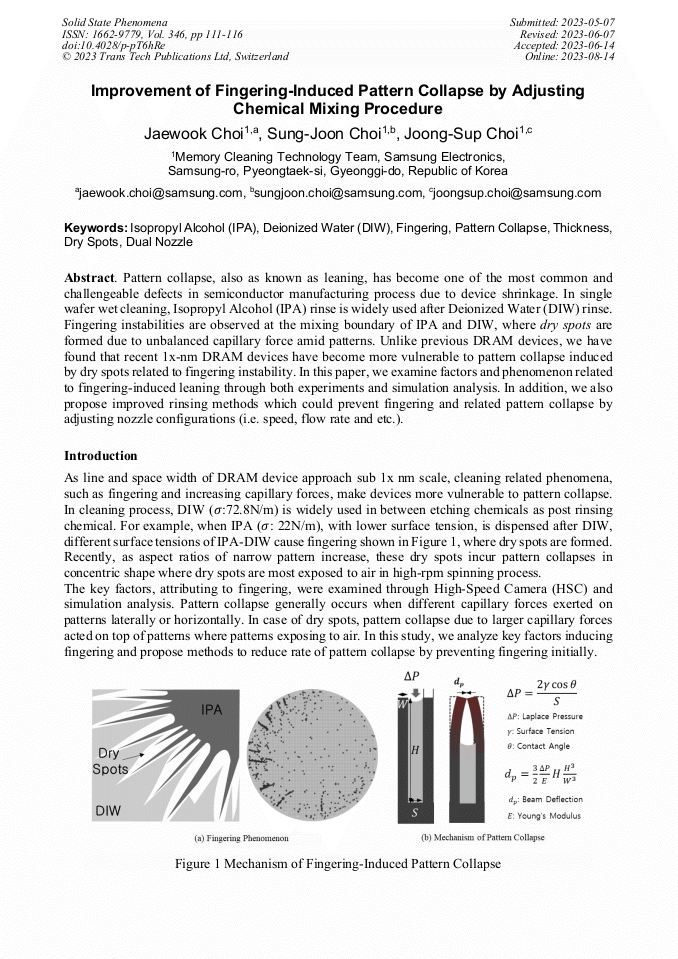
Pattern collapse, also as known as leaning, has become one of the most common and challengeable defects in semiconductor manufacturing process due to device shrinkage. In single wafer wet cleaning, Isopropyl Alcohol (IPA) rinse is widely used after Deionized Water (DIW) rinse. Fingering instabilities are observed at the mixing boundary of IPA and DIW, where dry spots are formed due to unbalanced capillary force amid patterns. Unlike previous DRAM devices, we have found that recent 1x-nm DRAM devices have become more vulnerable to pattern collapse induced by dry spots related to fingering instability. In this paper, we examine factors and phenomenon related to fingering-induced leaning through both experiments and simulation analysis. In addition, we also propose improved rinsing methods which could prevent fingering and related pattern collapse by adjusting nozzle configurations (i.e. speed, flow rate and etc.).
Info:
Periodical:
Pages:
111-116
DOI:
Citation:
Online since:
August 2023
Authors:
Price:
Permissions CCC:
Permissions PLS:
Сopyright:
© 2023 Trans Tech Publications Ltd. All Rights Reserved
Share:
Citation: