p.11
p.21
p.29
p.39
p.47
p.57
p.67
p.73
p.81
The Interaction of n- and r-Values and Total Elongation in Forming Limit Curves’ Theories

Abstract:
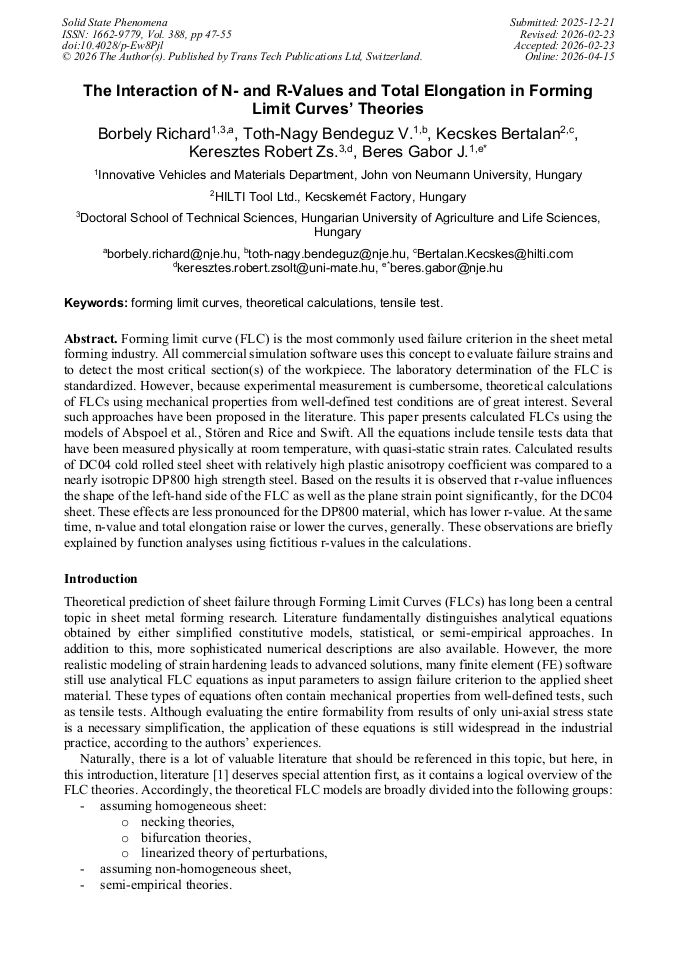
Forming limit curve (FLC) is the most common used manifestation of the failure criterion today in the sheet metal forming industry. All commercial simulation software uses this concept to evaluate the failure strains and to detect the most dangerous section(s) of the workpiece. The laboratory determination of the FLC is standardized. However, because experimental measurement is cumbersome, theoretical calculations of FLCs using mechanical properties from well-defined test conditions are still interesting. Such calculation concepts are already developed by different authors. This paper presents calculated FLCs using the models of Abspoel et al., Stören and Rice and Swift. All the equations include tensile tests data that have been measured physically at room temperature, with quasi-static strain rates. Calculated results of DC04 cold rolled steel sheet with relatively high plastic anisotropy coefficient was compared to a nearly isotropic DP800 high strength steel. Based on the results it is observed that r-value influences the shape of the left-hand side of the FLC as well as the plane strain point significantly, for the DC04 sheet. These effects are less pronounced for the DP800 material, which has lower r-value. At the same time, n-value and total elongation raise or lower the curves, generally. These observations are briefly explained by function analyses using fictitious r-values in the calculations.

Info:
Periodical:
Pages:
47-55
DOI:
Citation:
Online since:
April 2026
Permissions:
Share:
Citation: