p.1575
p.1581
p.1587
p.1593
p.1599
p.1605
p.1611
p.1617
p.1623
Influence of the Surface Topography on the Micromechanical Properties and Performance of a CMP Finished AlN Component for Silicon Plasma Etching

Abstract:
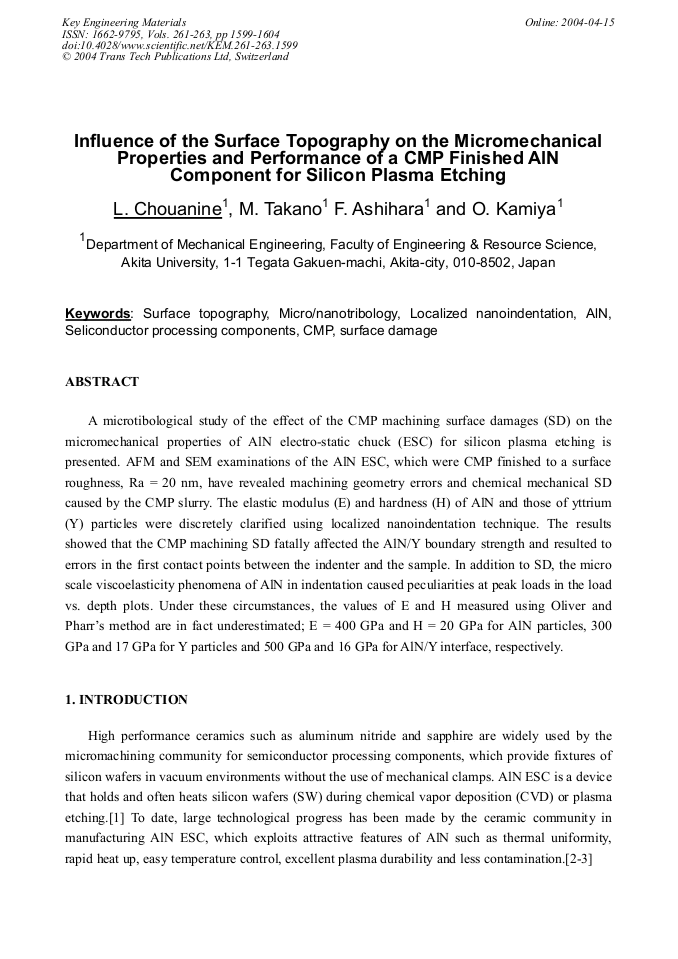
A microtibological study of the effect of the CMP machining surface damages (SD) on the micromechanical properties of AlN electro-static chuck (ESC) for silicon plasma etching is presented. AFM and SEM examinations of the AlN ESC, which were CMP finished to a surface roughness, Ra = 20 nm, have revealed machining geometry errors and chemical mechanical SD caused by the CMP slurry. The elastic modulus (E) and hardness (H) of AlN and those of yttrium (Y) particles were discretely clarified using localized nanoindentation technique. The results showed that the CMP machining SD fatally affected the AlN/Y boundary strength and resulted to errors in the first contact points between the indenter and the sample. In addition to SD, the micro scale viscoelasticity phenomena of AlN in indentation caused peculiarities at peak loads in the load vs. depth plots. Under these circumstances, the values of E and H measured using Oliver and Pharr's method are in fact underestimated; E = 400 GPa and H = 20 GPa for AlN particles, 300 GPa and 17 GPa for Y particles and 500 GPa and 16 GPa for AlN/Y interface, respectively.
Info:
Periodical:
Pages:
1599-1604
Citation:
Online since:
April 2004
Authors:
Price:
Сopyright:
© 2004 Trans Tech Publications Ltd. All Rights Reserved
Share:
Citation: