Simulation of Hydrogen Gas Production Process from Oil Palm Empty Fruit Bunch (OPEFB) Combine with Carbon Capture Based on Aspen Plus Software

Abstract:

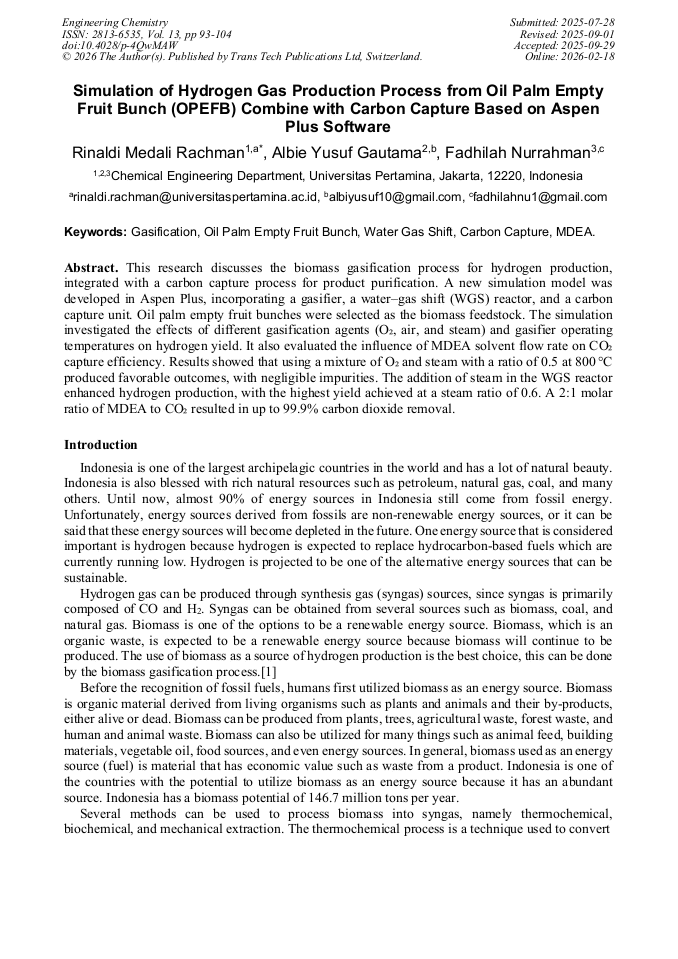
This research discusses the biomass gasification process for hydrogen production, integrated with a carbon capture process for product purification. A new simulation model was developed in Aspen Plus, incorporating a gasifier, a water–gas shift (WGS) reactor, and a carbon capture unit. Oil palm empty fruit bunches were selected as the biomass feedstock. The simulation investigated the effects of different gasification agents (O₂, air, and steam) and gasifier operating temperatures on hydrogen yield. It also evaluated the influence of MDEA solvent flow rate on CO₂ capture efficiency. Results showed that using a mixture of O₂ and steam with a ratio of 0.5 at 800 °C produced favorable outcomes, with negligible impurities. The addition of steam in the WGS reactor enhanced hydrogen production, with the highest yield achieved at a steam ratio of 0.6. A 2:1 molar ratio of MDEA to CO₂ resulted in up to 99.9% carbon dioxide removal.
You might also be interested in these eBooks

Info:

Periodical:

Engineering Chemistry (Volume 13)

Pages:

93-104

Citation:

Online since:

February 2026

Export:

Share:

Citation:

* - Corresponding Author

[1] V.V. Valsan, A.M. Manial, Comparative simulation study of hydrogen production by biomass gasification of different biomass feedstock with integrated carbon-dioxide capture, Government Engineering College, India, 2023.

DOI: 10.2139/ssrn.4483679

Google Scholar

[2] P. Nikolaidis, A. Poullikas, A comparative overview of hydrogen production processes, Cyprus University of Technology, Cyprus, 2017.

Google Scholar

[3] S. Safarian, R. Unnthorsson, C. Richer, Hydrogen production via biomass gasification: simulation and performance analysis under different gasifying agents, Biofuels (2021).

DOI: 10.1080/17597269.2021.1894781

Google Scholar

[4] P. Basu, Biomass Gasification, Pyrolysis, and Torrefaction, second ed., Dalhousie University and Greenfield Inc., 2013, p.147–246.

Google Scholar

[5] B.R.J. Smith, M. Loganathan, M.S. Shantha, A review of the water-gas shift reaction kinetics, Int. J. Chem. React. Eng. (2010).

Google Scholar

[6] S. Hasan, A.J. Abbas, G.G. Nasr, Improving the carbon capture efficiency for gas power plants through amine-based absorbents, University of Salford, United Kingdom, 2020.

DOI: 10.3390/su13010072

Google Scholar

[7] M.P. Gonzalez-Vazquez, F. Rubiera, C. Pevida, D.T. Pio, L.A.C. Tarelho, Thermodynamic analysis of biomass gasification using Aspen Plus: comparison of stoichiometric and non-stoichiometric models, Energies (2021).

DOI: 10.3390/en14010189

Google Scholar

[8] C. Antonini, F.P. Calvo Perez, M. Van Der Spek, M. Mazzotti, Optimal design of an MDEA CO₂ capture plant for low-carbon hydrogen production – a rigorous process optimization approach, ETH Zurich, Switzerland, 2021.

DOI: 10.1016/j.seppur.2021.119715

Google Scholar

[9] M. Oliviera, E. Monteiro, A. Rouboa, Optimizing hydrogen-rich biofuel production: syngas generation from wood chips and corn cobs, Energies (2024).

DOI: 10.3390/en17081859

Google Scholar

[10] W.M. Budzianowski, Energy Efficiency Solvent for CO₂ Capture by Gas-Liquid Absorption: Compounds, Blends, and Advanced Solvent System, Springer, 2016.

Google Scholar