Resistance to Fracture of Additively Manufactured Aluminium Alloy AlSi10Mg under Plane Stress Conditions

Article Preview

Abstract:

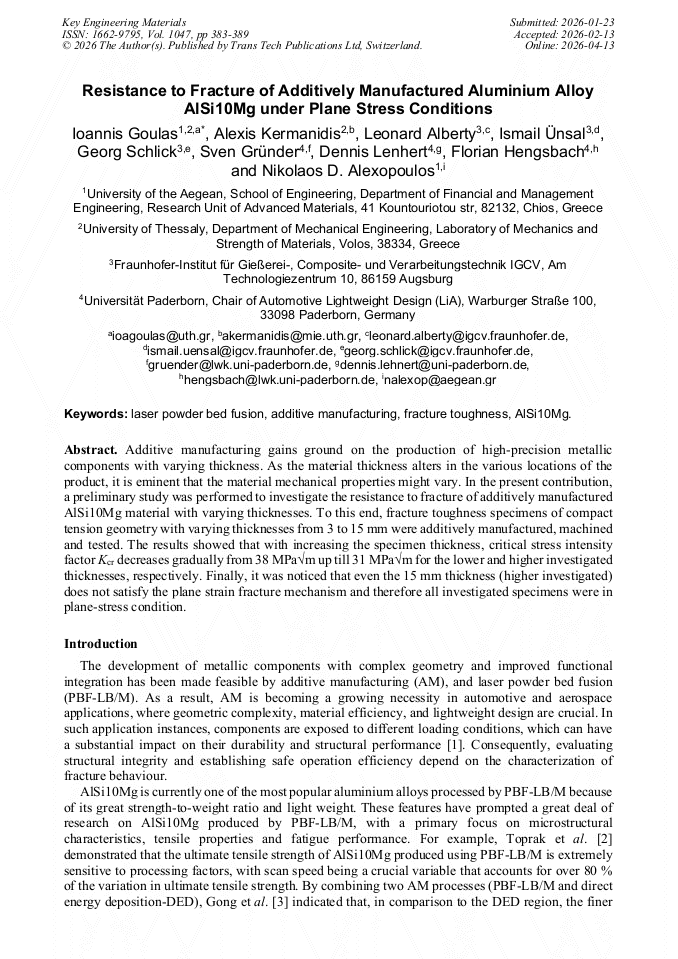
Additive manufacturing gains ground on the production of high-precision metallic components with varying thickness. As the material thickness alters in the various locations of the product, it is eminent that the material mechanical properties might vary. In the present contribution, a preliminary study was performed to investigate the resistance to fracture of additively manufactured AlSi10Mg material with varying thicknesses. To this end, fracture toughness specimens of compact tension geometry with varying thicknesses from 3 to 15 mm were additively manufactured, machined and tested. The results showed that with increasing the specimen thickness, critical stress intensity factor Kcr decreases gradually from 38 MPa√m up till 31 MPa√m for the lower and higher investigated thicknesses, respectively. Finally, it was noticed that even the 15 mm thickness (higher investigated) does not satisfy the plane strain fracture mechanism and therefore all investigated specimens were in plane-stress condition.
You might also be interested in these eBooks

Info:

* - Corresponding Author

[1] Zhao L, Song L, Santos Macías JG, Zhu Y, Huang M, Simar A, et al. Review on the correlation between microstructure and mechanical performance for laser powder bed fusion AlSi10Mg. Addit Manuf 2022;56.

DOI: 10.1016/j.addma.2022.102914

Google Scholar

[2] Toprak İB, Dogdu N. Optimization of tensile strength of AlSi10Mg material in the powder bed fusion process using the Taguchi method. Sci Rep 2024;14.

DOI: 10.1038/s41598-024-82541-1

Google Scholar

[3] Gong J, Wei K, Liu M, Song W, Li X, Zeng X. Microstructure and mechanical properties of AlSi10Mg alloy built by laser powder bed fusion/direct energy deposition hybrid laser additive manufacturing. Addit Manuf 2022;59.

DOI: 10.1016/j.addma.2022.103160

Google Scholar

[4] Wu Z, Wu S, Gao X, Lin Y, Xue Y, Withers PJ. The role of internal defects on anisotropic tensile failure of L-PBF AlSi10Mg alloys. Sci Rep 2023;13.

DOI: 10.1038/s41598-023-39948-z

Google Scholar

[5] Kramer S, Wexel H, Purwitasari A, Jarwitz M, Schulze V, Zanger F. Impact of different pore types on the tensile and fatigue properties of AlSi10Mg parts produced by laser powder bed fusion. Progress in Additive Manufacturing 2025;10:11305–17.

DOI: 10.1007/s40964-025-01288-x

Google Scholar

[6] Fini S, Croccolo D, De Agostinis M, Olmi G, Paiardini L, Scapecchi C, et al. Fatigue response of AlSi10Mg by laser powder bed fusion: influence of build orientation, heat, and surface treatments. Progress in Additive Manufacturing 2025;10:1385–403.

DOI: 10.1007/s40964-024-00712-y

Google Scholar

[7] Lupi G, Minerva G, Patriarca L, Casati R, Beretta S. Fracture toughness of AlSi10Mg alloy produced by LPBF: effects of orientation and heat treatment. Int J Fract 2024;247:329–44.

DOI: 10.1007/s10704-024-00787-2

Google Scholar