Effect of CuCr1Zr Cross-Contamination Level on Work Hardening Characteristics of AlSi10Mg Additive Manufactured Material

Article Preview

Abstract:

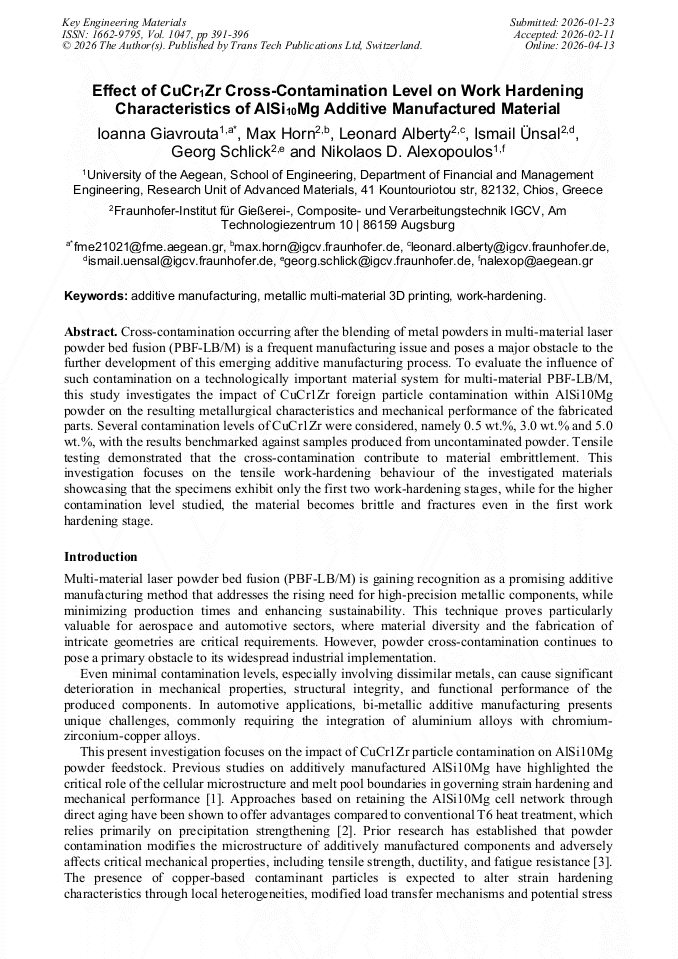
Cross-contamination occurring after the blending of metal powders in multi-material laser powder bed fusion (PBF-LB/M) is a frequent manufacturing issue and poses a major obstacle to the further development of this emerging additive manufacturing process. To evaluate the influence of such contamination on a technologically important material system for multi-material PBF-LB/M, this study investigates the impact of CuCr1Zr foreign particle contamination within AlSi10Mg powder on the resulting metallurgical characteristics and mechanical performance of the fabricated parts. Several contamination levels of CuCr1Zr were considered, namely 0.5 wt.%, 3.0 wt.% and 5.0 wt.%, with the results benchmarked against samples produced from uncontaminated powder. Tensile testing demonstrated that the cross-contamination contribute to material embrittlement. This investigation focuses on the tensile work-hardening behaviour of the investigated materials showcasing that the specimens exhibit only the first two work-hardening stages, while for the higher contamination level studied, the material becomes brittle and fractures even in the first work hardening stage.
You might also be interested in these eBooks

Info:

* - Corresponding Author

[1] E. Cerri, E. Ghio, On the work-hardening behaviour of the additively manufactured Al-Si-Mg alloys: Composite-like versus networked microstructure, Materialia 38 (2024) 102282.

DOI: 10.1016/j.mtla.2024.102282

Google Scholar

[2] J. Fite, S. E. Prameela, J. Slotwinski, T. P. Weihs, Enhanced mechanical properties by eutectic cells in AlSi10Mg – A promising paradigm for strengthening aluminum in additive manufacturing, Mater. Charact., 204, (2023).

DOI: 10.1016/j.matchar.2023.113179

Google Scholar

[3] M. Horn, G. Schlick, M. Lutter-Guenther, C. Anstaett, C. Seidel, G. Reinhart, Metal powder cross-contaminations in multi-material laser powder bed fusion: Influence of CuCr1Zr particles in AlSi10Mg feedstock on part properties, (LiM 2019), (2019).

DOI: 10.1016/j.procir.2020.09.032

Google Scholar

[4] N. D. Alexopoulos & M. Tiryakioğlu, Relationship between fracture toughness and tensile properties of A357 cast aluminum alloy, MMTA, 40, (2009), 702–716.

DOI: 10.1007/s11661-008-9742-8

Google Scholar

[5] C. Li, W.X. Zhang, H.O. Yang, J. Wan, X.X. Huang, Y.Z. Chen, Microstructural origin of high strength and high strain hardening capability of a laser powder bed fused AlSi10Mg alloy, J. Mat. Sci. Technol. 197 (2024), 194–206.

DOI: 10.1016/j.jmst.2024.01.067

Google Scholar

[6] M. Avateffazeli, S. I. Shakil, A. Hadadzadeh, B. Shalchi-Amirkhiz, H. Pirgazi, M. Mohammadi, M. Haghshenas, On microstructure and work hardening behavior of laser powder bed fused Al-Cu-Mg-Ag-TiB₂ and AlSi10Mg alloys, Mater. Today Commun., 35 (2023) 105804.

DOI: 10.1016/j.mtcomm.2023.105804

Google Scholar

[7] R. Ramesh, S. Gairola, R. Jayaganthan, M. Kamaraj, Effects of post-processing on the microstructural evolution and mechanical behaviour of an additively manufactured AlSi10Mg alloy, J. Mat. Res. Technol. 34, (2025), 2802–2813.

DOI: 10.1016/j.jmrt.2024.12.248

Google Scholar