Simplifying the Methodology to Estimate the Separation Time of a Particle at 1-g under Unsteady Conditions

Article Preview

Abstract:

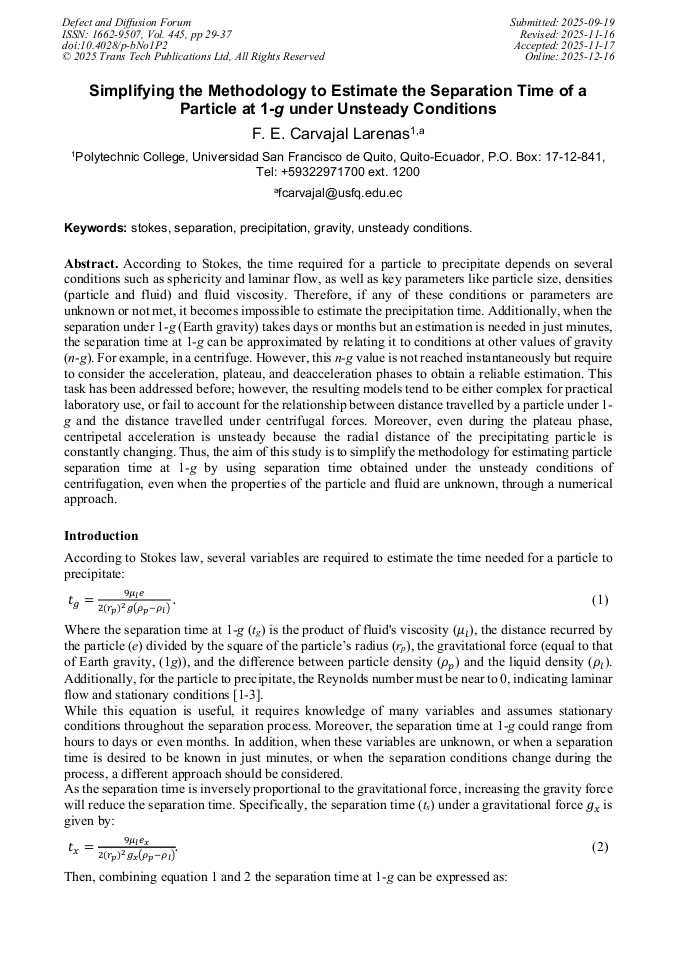
According to Stokes, the time required for a particle to precipitate depends on several conditions such as sphericity and laminar flow, as well as key parameters like particle size, densities (particle and fluid) and fluid viscosity. Therefore, if any of these conditions or parameters are unknown or not met, it becomes impossible to estimate the precipitation time. Additionally, when the separation under 1-g (Earth gravity) takes days or months but an estimation is needed in just minutes, the separation time at 1-g can be approximated by relating it to conditions at other values of gravity (n-g). For example, in a centrifuge. However, this n-g value is not reached instantaneously but require to consider the acceleration, plateau, and deacceleration phases to obtain a reliable estimation. This task has been addressed before; however, the resulting models tend to be either complex for practical laboratory use, or fail to account for the relationship between distance travelled by a particle under 1-g and the distance travelled under centrifugal forces. Moreover, even during the plateau phase, centripetal acceleration is unsteady because the radial distance of the precipitating particle is constantly changing. Thus, the aim of this study is to simplify the methodology for estimating particle separation time at 1-g by using separation time obtained under the unsteady conditions of centrifugation, even when the properties of the particle and fluid are unknown, through a numerical approach.
You might also be interested in these eBooks

Info:

Periodical:

Pages:

29-37

Citation:

Online since:

December 2025

Export:

Price:

Permissions CCC:

Permissions PLS:

Сopyright:

© 2025 Trans Tech Publications Ltd. All Rights Reserved

Share:

Citation:

* - Corresponding Author

[1] J. Crank. The Mathematics of Diffusion. second ed., Oxford University Press, New York, 2011.

Google Scholar

[2] R.E. Treybal, Mass-Transfer Operations, third ed., McGraw-Hill Company, Singapore, 1981.

Google Scholar

[3] A. Ibartz, G.V. Barbosa-Cánovas, Operaciones Unitarias en la Ingeniería de Alimentos, Ediciones Mundi-Prensa, Madrid, 2005.

Google Scholar

[4] M. A. Whittlesey, Spherical Geometry and Its Applications. CRC Press, Boca Raton, FL, 2020.

Google Scholar

[5] F.E. Carvajal-Larenas, Increasing the certainty to estimate 1-gravity (1-g) separation time based on any-g force (n) and g-equivalent concepts, Defect and Diffusion Forum. 420 (2022) 19-25.

DOI: 10.4028/p-txpoi1

Google Scholar

[6] P. Li, J. Huang, L. Luo, Y. Kuang, X. Sun, Universal Parameter Optimization of Density Gradient Ultracentrifugation Using CdSe Nanoparticles as Tracing Agents, Analytical Chemistry. 88 (2016) 8495 - 8501.

DOI: 10.1021/acs.analchem.6b01092

Google Scholar

[7] P. Li, A. Kumar, J. Ma, Y. Kuang, L. Luo, X. Sun, Density gradient ultracentrifugation for colloidal nanostructures separation and investigation, Science Bulletin. 63 (2018) 645 - 662.

DOI: 10.1016/j.scib.2018.04.014

Google Scholar

[8] Y. Kuang, S. Song, J. Huang, X. Sun, Separation of colloidal two dimensional materials by density gradient ultracentrifugation, Journal of Solid State Chemistry. 224 (2015) 120-126.

DOI: 10.1016/j.jssc.2014.09.033

Google Scholar

[9] L. Bai, X. Ma, J. Liu, X. Sun, D. Zhao, D.G. Evans, Rapid separation and purification of nanoparticles in organic density gradients, Journal of the American Chemical Society, 132 (2010) 2333 - 2337.

DOI: 10.1021/ja908971d

Google Scholar

[10] J.H. Sim, H.N. Umh, H.H. Shin, H.K. Sung, S.Y. Oh, B.C. Lee, R. Selvaraj, Y. Kim, Regeneration of aged-AgNPs via density gradient ultracentrifugal nanoseparation, Journal of Industrial and Engineering Chemistry. 20 (2014) 3157 - 3162.

DOI: 10.1016/j.jiec.2013.11.059

Google Scholar

[11] L. Deng, X. Wang, Y. Kuang, C. Wang, L. Luo, F. Wang, X. Sun, Development of hydrophilicity gradient ultracentrifugation method for photoluminescence investigation of separated non-sedimental carbon dots, Nano Research, 8 (2015). 2810 - 2821.

DOI: 10.1007/s12274-015-0786-y

Google Scholar

[12] X. Ma, Y. Kuang, L. Bai, Z. Chang, F. Wang, X. Sun, D.G. Evans, Experimental and mathematical modelling studies of the separation of zinc blende and wurtzite phases of CdS nanorods by density gradient ultracentrifugation, ACS Nano. 5 (2011) 3242 - 3249.

DOI: 10.1021/nn200374t

Google Scholar