Improvements in Electrical Properties of SiC Surface Using Mechano-Chemical Polishing
p.823
p.823
The Impact of Chemical-Mechanical Polishing on Defective 4H-SiC Schottky Barrier Diodes
p.827
p.827
Effect of Process Parameters on Material Removal Rate in Chemical Mechanical Polishing of 6H-SiC(0001)
p.831
p.831
Damage-Free Planarization of 2-Inch 4H-SiC Wafer Using Pt Catalyst Plate and HF Solution
p.835
p.835
The Preparation of World-Class Single Crystal Silicon Carbide Wafers Using High Rate Chemical Mechanical Planarization Slurries
p.839
p.839
Beveling of Silicon Carbide Wafer by Plasma Chemical Vaporization Machining
p.843
p.843
Temperature Dependence of Plasma Chemical Vaporization Machining of Silicon and Silicon Carbide
p.847
p.847
Electric Discharge Machining for Silicon Carbide and Related Materials
p.851
p.851
Characterization of Electric Discharge Machining for Silicon Carbide Single Crystal
p.855
p.855
The Preparation of World-Class Single Crystal Silicon Carbide Wafers Using High Rate Chemical Mechanical Planarization Slurries

Abstract:
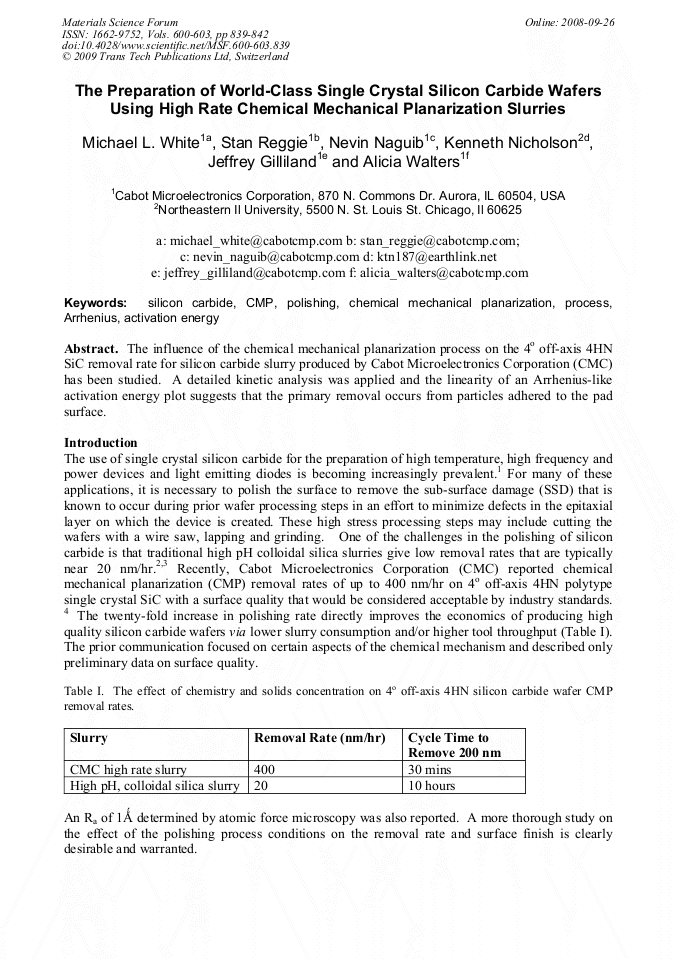
The influence of the chemical mechanical planarization process on the 4o off-axis 4HN SiC removal rate for silicon carbide slurry produced by Cabot Microelectronics Corporation (CMC) has been studied. A detailed kinetic analysis was applied and the linearity of an Arrhenius-like activation energy plot suggests that the primary removal occurs from particles adhered to the pad surface.
You might also be interested in these eBooks
Info:
Periodical:
Materials Science Forum (Volumes 600-603)
Pages:
839-842
Citation:
Online since:
September 2008
Price:
Сopyright:
© 2009 Trans Tech Publications Ltd. All Rights Reserved
Share:
Citation: