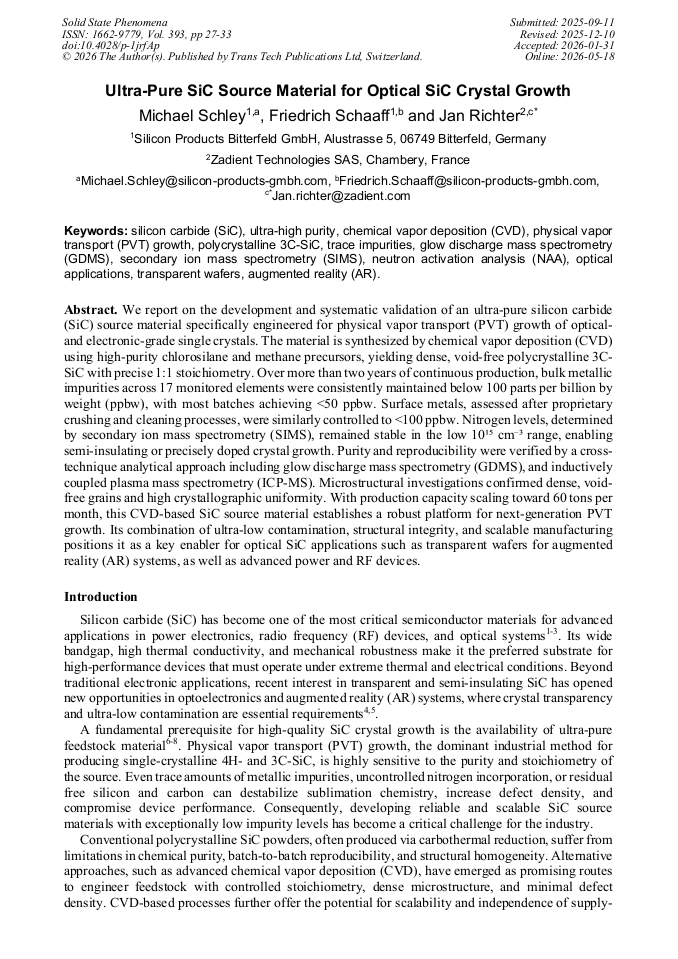
Ultra-Pure SiC Source Material for Optical SiC Crystal Growth

Article Preview

Abstract:

We report on the development and systematic validation of an ultra-pure silicon carbide (SiC) source material specifically engineered for physical vapor transport (PVT) growth of optical-and electronic-grade single crystals. The material is synthesized by chemical vapor deposition (CVD) using high-purity chlorosilane and methane precursors, yielding dense, void-free polycrystalline 3C-SiC with precise 1:1 stoichiometry. Over more than two years of continuous production, bulk metallic impurities across 17 monitored elements were consistently maintained below 100 parts per billion by weight (ppbw), with most batches achieving <50 ppbw. Surface metals, assessed after proprietary crushing and cleaning processes, were similarly controlled to <100 ppbw. Nitrogen levels, determined by secondary ion mass spectrometry (SIMS), remained stable in the low 10¹⁵ cm⁻³ range, enabling semi-insulating or precisely doped crystal growth. Purity and reproducibility were verified by a cross-technique analytical approach including glow discharge mass spectrometry (GDMS), and inductively coupled plasma mass spectrometry (ICP-MS). Microstructural investigations confirmed dense, void-free grains and high crystallographic uniformity. With production capacity scaling toward 60 tons per month, this CVD-based SiC source material establishes a robust platform for next-generation PVT growth. Its combination of ultra-low contamination, structural integrity, and scalable manufacturing positions it as a key enabler for optical SiC applications such as transparent wafers for augmented reality (AR) systems, as well as advanced power and RF devices.
You have full access to the following eBook

Info:

* - Corresponding Author

[1] Kimoto, T., & Cooper, J. A. (2014). Fundamentals of Silicon Carbide Technology: Growth, Characterization, Devices and Applications. Wiley-IEEE Press.

DOI: 10.1002/9781118313534

Google Scholar

[2] Choyke, W. J., Matsunami, H., & Pensl, G. (Eds.). (2004). Silicon Carbide: Recent Major Advances. Springer.

DOI: 10.1007/978-3-642-18870-1

Google Scholar

[3] Kordina, O., Saddow, S. E., Kimoto, T., & Agarwal, A. (2021). Silicon Carbide Power Devices. Elsevier.

Google Scholar

[4] Rupp, R., et al. (2018). "Ultra-high-purity SiC and its role in power electronics." Journal of Crystal Growth, 498, 380–387.

Google Scholar

[5] Murakami, H., et al. (2020). "Advances in bulk SiC crystal growth for optical and power applications." Applied Physics Express, 13(12), 120101.

Google Scholar

[6] Größmann, I., et al. (2021). "Method and device for producing a SiC solid material." International patent application WO 2022123072.

Google Scholar

[7] Ceran, K., et al. (2022). "Method for producing at least one crack-free SiC piece." International patent application WO 2023222787.

Google Scholar

[8] Größmann, I., et al. (2024). "Method and system for SIC production and improved vent gas recycling." International patent application WO2025051945.

Google Scholar

[9] Hofmann, S., & Rauschenbach, B. (1990). "Glow discharge mass spectrometry in materials science." Surface and Interface Analysis, 16(9), 577–582.

Google Scholar

[10] Itoh, A., Okumura, H., & Matsunami, H. (1995). "Quantitative analysis of nitrogen in 4H-SiC epilayers by secondary ion mass spectrometry." Journal of Applied Physics, 77(11), 837–843.

Google Scholar

[11] Rossotti, F. J., et al. (2023). "Tackling the Challenging Determination of Trace Elements in Ultrapure SiC via LA-ICP-MS." Molecules, 28(6), 2845.

DOI: 10.3390/molecules28062845

Google Scholar

[12] Fraunhofer Center for Silicon Photovoltaics CSP. (n.d.). "Surface contamination analysis, high-sensitivity ICP-MS of SiC materials." Fraunhofer CSP Ultratrace Analysis Service. csp.fraunhofer.de.

Google Scholar

[13] Toray Research Center, Inc. (2016). "High-sensitive analysis of metal impurities on Si & SiC substrates—ICP-MS methods." Toray Technical Information Series.

Google Scholar

[14] Ruska, J., Lugovy, M., & Kordina, O. (2001). "Accuracy of X-ray diffraction SiC polytype-composition analyses." Journal of Materials Synthesis and Processing, 9(4), 211–218.

Google Scholar

[15] Gauckler, L. J., & Scherrer, P. (2003). "Quantitative polytype-composition analyses of SiC using X-ray diffraction." Journal of Materials Processing Technology, 136(1–3), 191–197.

Google Scholar

[16] Wyatt, C. N., & Blackson, J. (2016). "Using XRD and TGA-DSC to characterize a silicon carbide powder." Kansas State University Undergraduate Research Reports, 12, 1–7.

Google Scholar

[17] Kumar, G., Chen, J.-W., Ma, H.-H., Huang, X.-F., & Huang, M. H. (2022). Facet-dependent electrical conductivity properties of a 4H-SiC wafer. Journal of Materials Chemistry C, 10(28), 10424–10428.

DOI: 10.1039/d2tc01981g

Google Scholar