Carbon Vacancy Engineering on High-Temperature Annealing as a Cost-Effective Approach for Reverse Recovery Suppression in SiC-MOSFETs

Article Preview

Abstract:

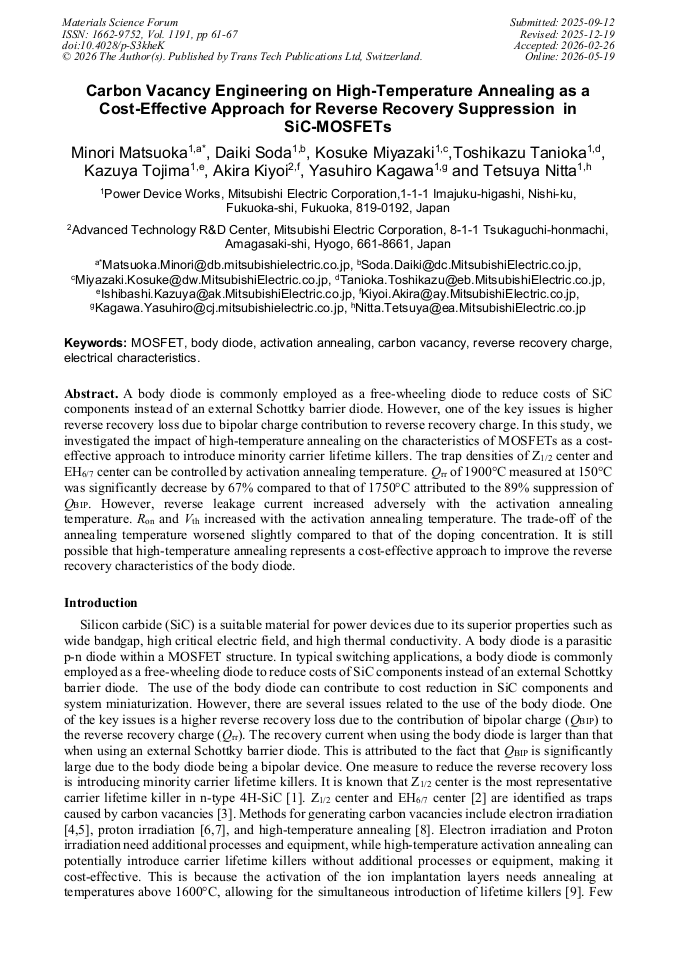
A body diode is commonly employed as a free-wheeling diode to reduce costs of SiC components instead of an external Schottky barrier diode. However, one of the key issues is higher reverse recovery loss due to bipolar charge contribution to reverse recovery charge. In this study, we investigated the impact of high-temperature annealing on the characteristics of MOSFETs as a cost-effective approach to introduce minority carrier lifetime killers. The trap densities of Z1/2 center and EH6/7 center can be controlled by activation annealing temperature. Qrr of 1900°C measured at 150°C was significantly decrease by 67% compared to that of 1750°C attributed to the 89% suppression of QBIP. However, reverse leakage current increased adversely with the activation annealing temperature. Ron and Vth increased with the activation annealing temperature. The trade-off of the annealing temperature worsened slightly compared to that of the doping concentration. It is still possible that high-temperature annealing represents a cost-effective approach to improve the reverse recovery characteristics of the body diode.
You have full access to the following eBook

Info:

* - Corresponding Author

[1] K. Danno, T. Hori and T. Kimoto, Impacts of growth parameters on deep levels in n-type 4H-SiC, J. Appl. Phys. 101, 053709 (2007).

DOI: 10.1063/1.2437666

Google Scholar

[2] N. T. Son, X. T. Trinh, L. S. Løvlie, B. G. Svensson, K. Kawahara, J. Suda, T. Kimoto, T. Umeda, J. Isoya, T. Makino, T. Ohshima, and E. Janze, Negative-𝑈 System of Carbon Vacancy in 4𝐻-SiC, Phys. Rev. Lett. 109, 187603 (2012).

DOI: 10.1103/physrevlett.109.187603

Google Scholar

[3] G. Alfieri and T. Kimoto, Resolving the level in 4H-SiC by Laplace-transform deep level transient spectroscopy, Appl. Phys. Lett. 102, 152108 (2013).

DOI: 10.1063/1.4802248

Google Scholar

[4] P. Dong, Y. Qin, X. Yu, X. Xu, Z. Chen and L. Li, Electron Radiation Effects on the 4H-SiC PiN Diodes Characteristics: An Insight from Point Defects to Electrical Degradation, IEEE Access. 7, 170385 (2019).

DOI: 10.1109/access.2019.2955385

Google Scholar

[5] T. Kimoto and K. Danno, Lifetime-killing defects in 4H-SiC epilayers and lifetime control by low-energy electron irradiation, phys. stat. sol. (b) 245, 1213 (2008).

DOI: 10.1002/pssb.200844076

Google Scholar

[6] A Castaldini, A Cavallini and L Rigutti Assessment of the intrinsic nature of deep level Z1/Z2 by compensation effects in proton-irradiated 4H-SiC, Semicond. Sci. Technol. 21 (2006) 724–728.

DOI: 10.1088/0268-1242/21/6/002

Google Scholar

[7] P. Hazdra and S. Popelka, Optimization of SiC Power p-i-n Diode Parameters by Proton Irradiation, IEEE Access. 65, 4483 (2018).

DOI: 10.1109/ted.2018.2866763

Google Scholar

[8] E. Saito, J. Suda and T. Kimoto, Control of carrier lifetime of thick n-type 4H-SiC epilayers by high-temperature Ar annealing, Appl. Phys. Exp. 9, 061303 (2016).

DOI: 10.7567/apex.9.061303

Google Scholar

[9] M. Spera, D. Corso, S. Di Franco, G. Greco, A. Severino, P. Fiorenza, F. Giannazzo and F. Roccaforte, Effect of high temperature annealing (T > 1650 °C) on the morphological and electrical properties of p-type implanted 4H-SiC layers, . Mater. Sci. Semicond. Proc. 93 (2019) 274–279.

DOI: 10.1016/j.mssp.2019.01.019

Google Scholar