p.29
p.37
p.43
p.49
p.55
p.61
p.69
p.75
p.81
4H-SiC Diodes to Probe Stark Effect Detection in 7Be Decay Lifetime

Abstract:
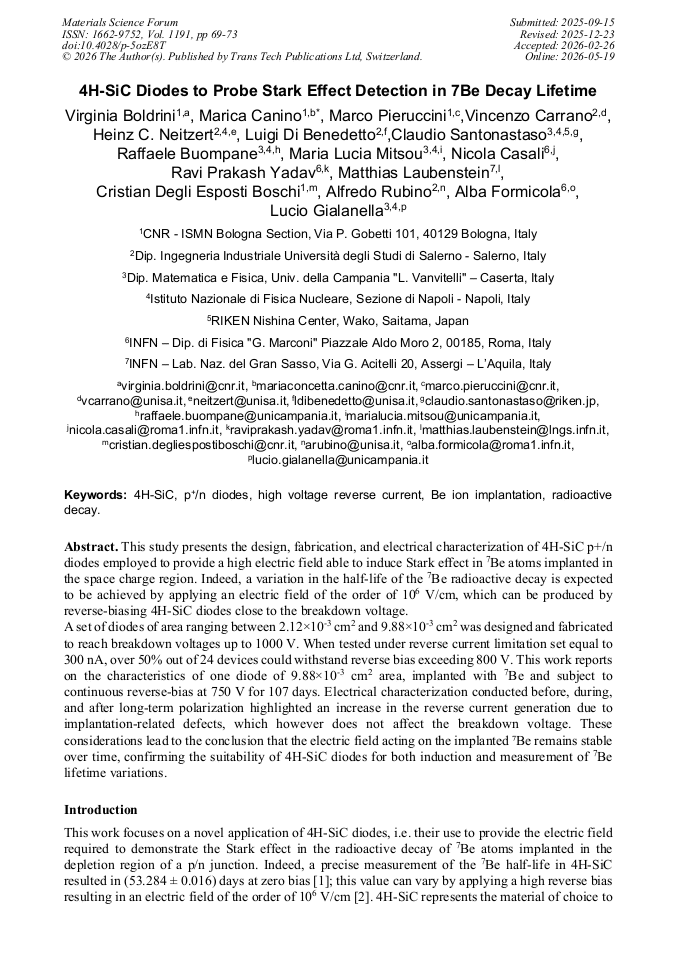
This study presents the design, fabrication, and electrical characterization of 4H-SiC PIN diodes employed to provide a high electric field able to induce Stark effect in 7Be atoms implanted in the space charge region. Indeed, a variation in the half-life of the 7Be radioactive decay is expected to be achieved by applying an electric field of the order of 106 V/cm, which can be produced by reverse-biasing 4H-SiC diodes close to the breakdown voltage. A set of diodes of area ranging between 2.12×10⁻³ cm2 and 9.88×103 cm2 was designed and fabricated to reach breakdown voltages up to 1000 V. When tested under reverse current limitation set equal to 300 nA, over 50% out of 24 devices could withstand reverse bias exceeding 800 V. This work reports on the characteristics of one diode of 9.88×103 cm2 area, implanted with 7Be and subject to continuous reverse-bias at 750 V for 107 days. Electrical characterization conducted before, during, and after long-term polarization highlighted an increase in the reverse current generation due to implantation-related defects, which however does not affect the breakdown voltage. These considerations lead to the conclusion that the electric field acting on the implanted ⁷Be remains stable over time, confirming the suitability of 4H-SiC diodes for both induction and measurement of 7Be lifetime variations.
Info:
Periodical:
Pages:
69-73
DOI:
Citation:
Online since:
May 2026
Authors:
Permissions:
Share:
Citation: