Depth-Dependent Suppression of Bipolar Degradation in 4H-SiC Diodes via Proton Implantation and Evaluation of Safe Operating Current Density Range

Article Preview

Abstract:

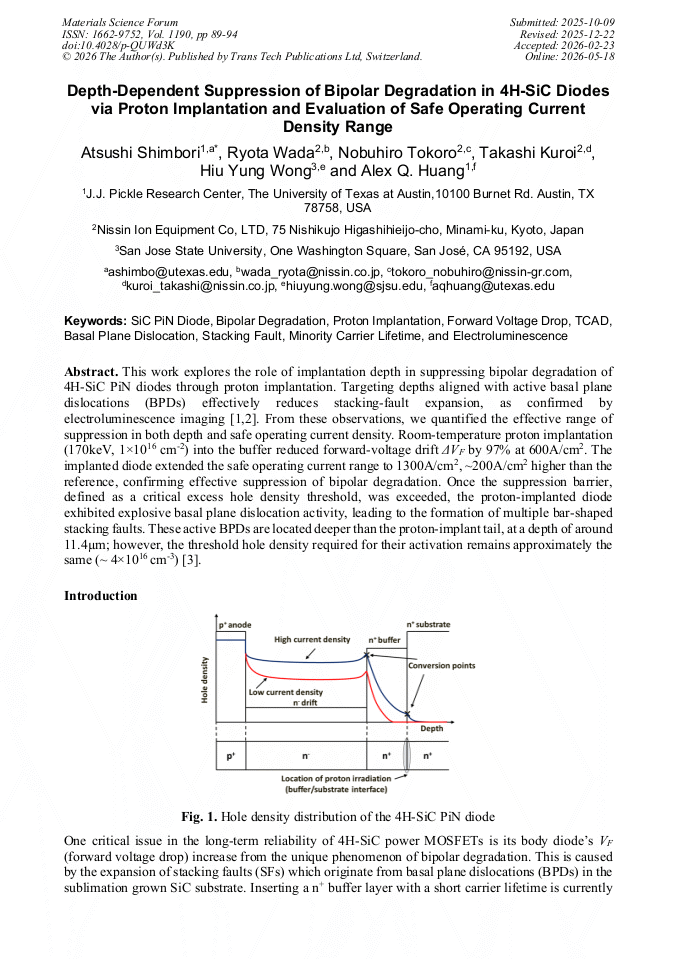
This work explores the role of implantation depth in suppressing bipolar degradation of 4H-SiC PiN diodes through proton implantation. Targeting depths aligned with active basal plane dislocations (BPDs) effectively reduces stacking-fault expansion, as confirmed by electroluminescence imaging [1,2]. From these observations, we quantified the effective range of suppression in both depth and safe operating current density. Room-temperature proton implantation (170keV, 1×1016 cm-2) into the buffer reduced forward-voltage drift ΔVF by 97% at 600A/cm2. The implanted diode extended the safe operating current range to 1300A/cm2, ~200A/cm2 higher than the reference, confirming effective suppression of bipolar degradation. Once the suppression barrier, defined as a critical excess hole density threshold, was exceeded, the proton-implanted diode exhibited explosive basal plane dislocation activity, leading to the formation of multiple bar-shaped stacking faults. These active BPDs are located deeper than the proton-implant tail, at a depth of around 11.4µm; however, the threshold hole density required for their activation remains approximately the same (~ 4×1016 cm-3) [3].

You have full access to the following eBook

Info:

* - Corresponding Author

[1] M. Kato, O. Watanabe, T. Mii, H. Sakane, and S. Harada, "Suppression of stacking-fault expansion in 4H-SiC PiN diodes using proton implantation to solve bipolar degradation," Sci. Rep., vol. 12, art. no. 18790, 2022.

DOI: 10.1038/s41598-022-23691-y

Google Scholar

[2] T. Li, H. Sakane, S. Harada, and M. Kato, "Suppression of stacking fault expansion by backside proton implantation into SiC substrates," Mater. Sci. Semicond. Process., vol. 203, art. no. 110262, 2026.

DOI: 10.1016/j.mssp.2025.110262

Google Scholar

[3] A. Shimbori, R. Wada, N. Tokoro, T. Kuroi, H. Y. Wong, and A. Q. Huang, "Estimation of threshold hole density in single Shockley stacking fault expansion and its suppression through proton implantation in 4H-SiC PiN diodes," 2025 Device Research Conference (DRC), Durham, NC, USA, 2025, pp.1-2.

DOI: 10.1109/DRC66027.2025.11105740

Google Scholar

[4] T. Kimoto et al., "Understanding and reduction of degradation phenomena in SiC power devices," 2017 IEEE International Reliability Physics Symposium (IRPS), Monterey, CA, USA, 2017, pp. 2A-1.1-2A-1.7

DOI: 10.1109/IRPS.2017.7936253

Google Scholar

[5] S. Harada, T. Mii, H. Sakane, and M. Kato, "Suppression of stacking-fault expansion in a 4H-SiC epitaxial layer by proton irradiation," Sci. Rep., vol. 12, art. no. 13542, 2022.

DOI: 10.1038/s41598-022-17060-y

Google Scholar

[6] T. Mii, H. Sakane, S. Harada, and M. Kato, "Analysis of carrier lifetime in a drift layer of 1.2-kV-class 4H-SiC devices toward complete suppression of bipolar degradation," Mater. Sci. Semicond. Process., vol. 153, art. no. 107126, 2023.

DOI: 10.1016/j.mssp.2022.107126

Google Scholar

[7] M. Kato, S. Harada, and H. Sakane, "Effects of proton implantation for expansion of basal plane dislocations in SiC toward suppression of bipolar degradation: Review and perspective," Jpn. J. Appl. Phys., vol. 63, no. 2, art. no. 020804, Jan. 2024.

DOI: 10.35848/1347-4065/ad1779

Google Scholar

[8] T. Li, H. Sakane, S. Harada, and M. Kato, "Suppression of stacking-fault expansion in 4H-SiC diodes by helium implantation," Appl. Phys. Express, vol. 17, no. 8, p.086503, Aug. 2024.

DOI: 10.35848/1882-0786/ad6be5

Google Scholar